The Sector That Stopped Moving
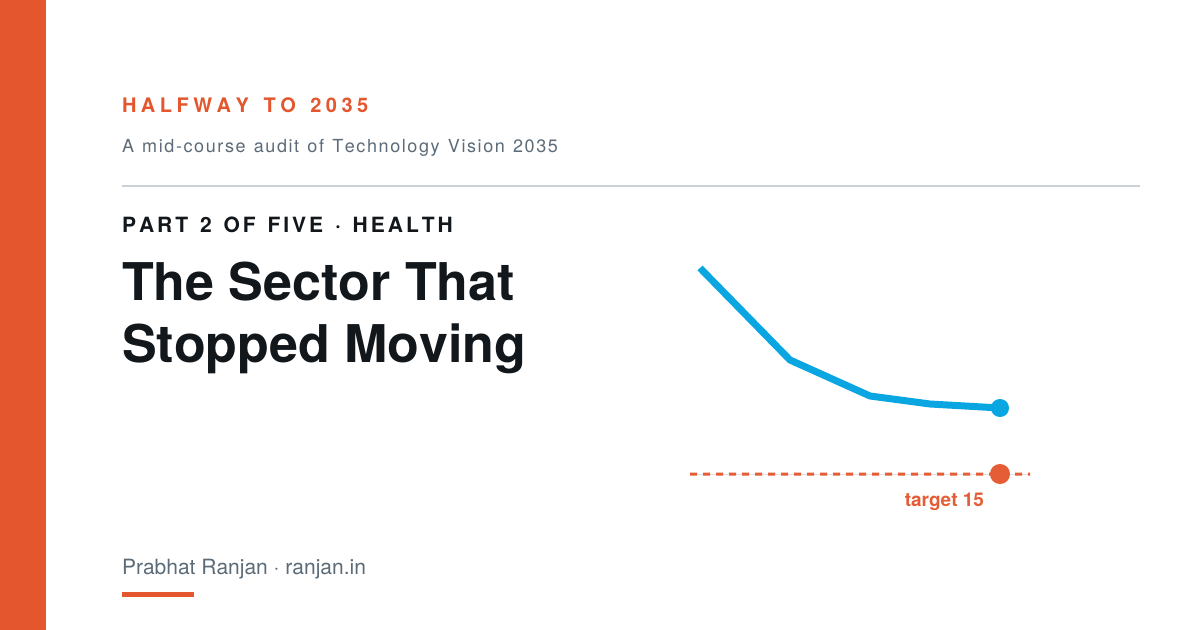
The medical sciences roadmap was the most quantitatively explicit of the twelve. That is to its credit, and it is why the sector can be graded harder than any other.
Prof. Prabhat Ranjan CEO and Co-founder of a nuclear fusion company called ASPL Fusion. He is former Vice Chancellor of D Y Patil International University, Akurdi, Pune

The medical sciences roadmap was the most quantitatively explicit of the twelve. That is to its credit, and it is why the sector can be graded harder than any other.
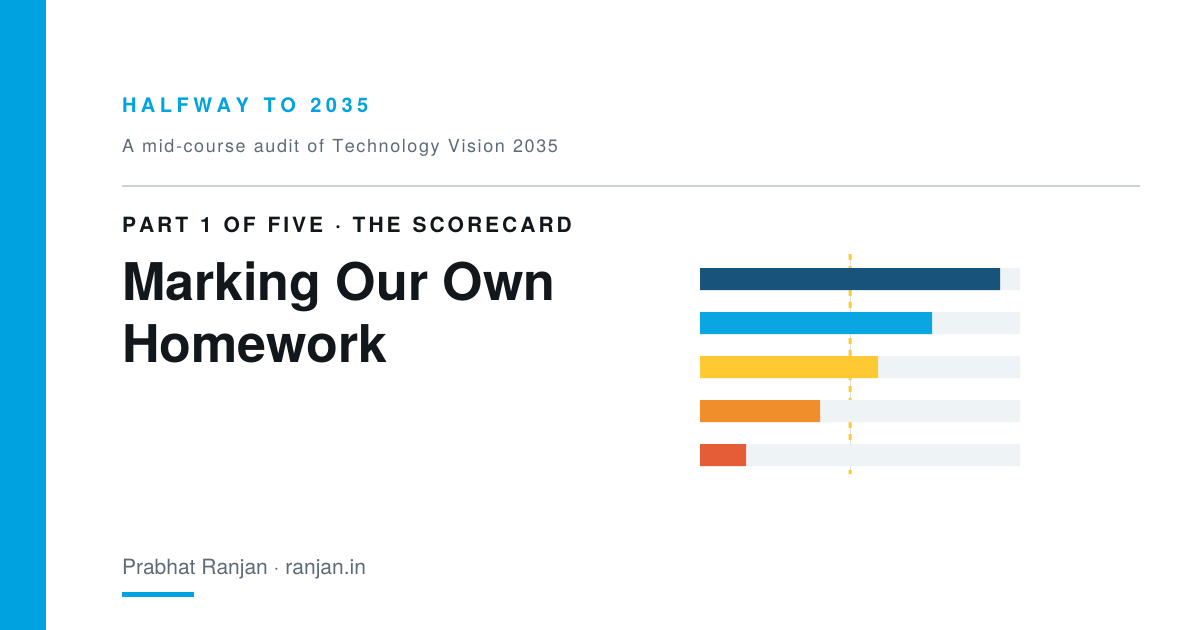
Technology Vision 2035 named twelve prerogatives, ten Grand Challenges and hard figures with a date attached. Ten years and seven months of the twenty are gone.
This is the audit, done in public, against our own numbers.
India’s electricity demand will nearly quadruple by 2047. Solar and wind cannot carry that load alone. The time to build the next generation of baseload is not 2040 — it is today and why fusion must be a strong part of it.
India’s electricity demand will nearly quadruple by 2047. Solar and wind cannot carry that load alone. The time to build the next generation of baseload is not 2040 — it is today.
Disclosure: The author is co-founder of ASPL Fusion, a private Indian fusion company. This article presents an industry perspective on national energy policy. The policy arguments are grounded in publicly available data; the ASPL programme description in Section 5 is provided as a concrete illustration of what a domestic fusion development path can look like in practice.
708 GW peak demand and 2,100 GW total capacity needed by 2047 — the equivalent of building a new US power grid from scratch.
Intermittent renewables alone cannot provide firm power — grid stability requires large-scale dispatchable baseload even with abundant storage.
Fusion now has serious private capital behind it: Microsoft, Google, and OpenAI are structuring power purchase agreements with fusion companies. India risks being a technology importer.
Three budget-cycle asks for 2026: fusion in National Energy Plan · dedicated component development fund · AERB regulatory engagement mandate.
India’s Central Electricity Authority projects peak power demand reaching 708 GW by 2047 — four times today’s installed capacity. Meeting it requires 2,100 GW of generation: close to the entire current installed capacity of the US and EU combined. That is the scale of infrastructure build India must manage across the next two decades.
Excerpts from book Chapter “Emerging and Disruptive Technologies” – Authored by Prof Prabhat Ranjan,
Book – “Strategic Challenges : India in 2030” – Edited by Jayadeva Ranade, Published by HarperCollins India in September 2022
Emerging and disruptive technologies are reshaping modern security frameworks and warfare strategies. These innovations, ranging from artificial intelligence (AI) to hypersonic missiles, hold the potential to redefine national defense mechanisms, economic policies, and international diplomacy. This detailed analysis explores the scope, challenges, and implications of these technologies, particularly from an Indian perspective.
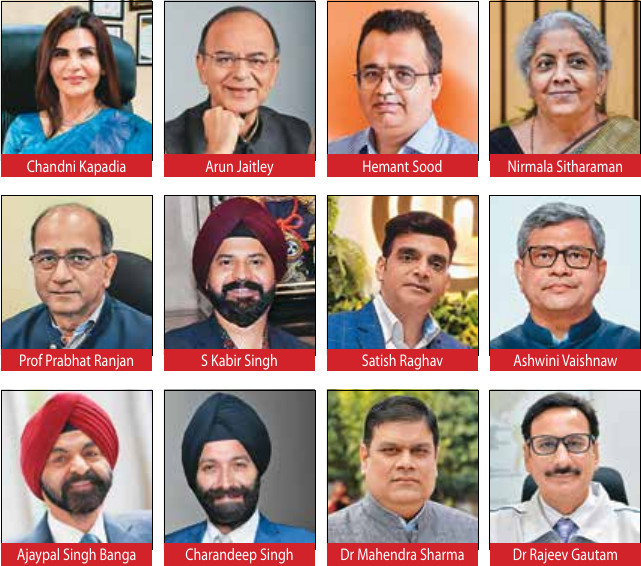
Continue reading ““Emerging and Disruptive Technologies” – Strategic Challenges : India in 2030”Prof Prabhat Ranjan has been identified by Outlook Magazine as one of the visionaries to take India towards a $ 5 Trillion economy
The International Monetary Fund (IMF) has projected India to become a $5 trillion economy with the third largest GDP in 2027-28, early in the ‘Amrit Kaal’ on the path to achieving the goal of becoming an advanced economy by 2047. “Outlook” magazine has tried to identify “visionaries” of India under whose guidance, India is moving towards achieving this goal in a special anniversary edition.
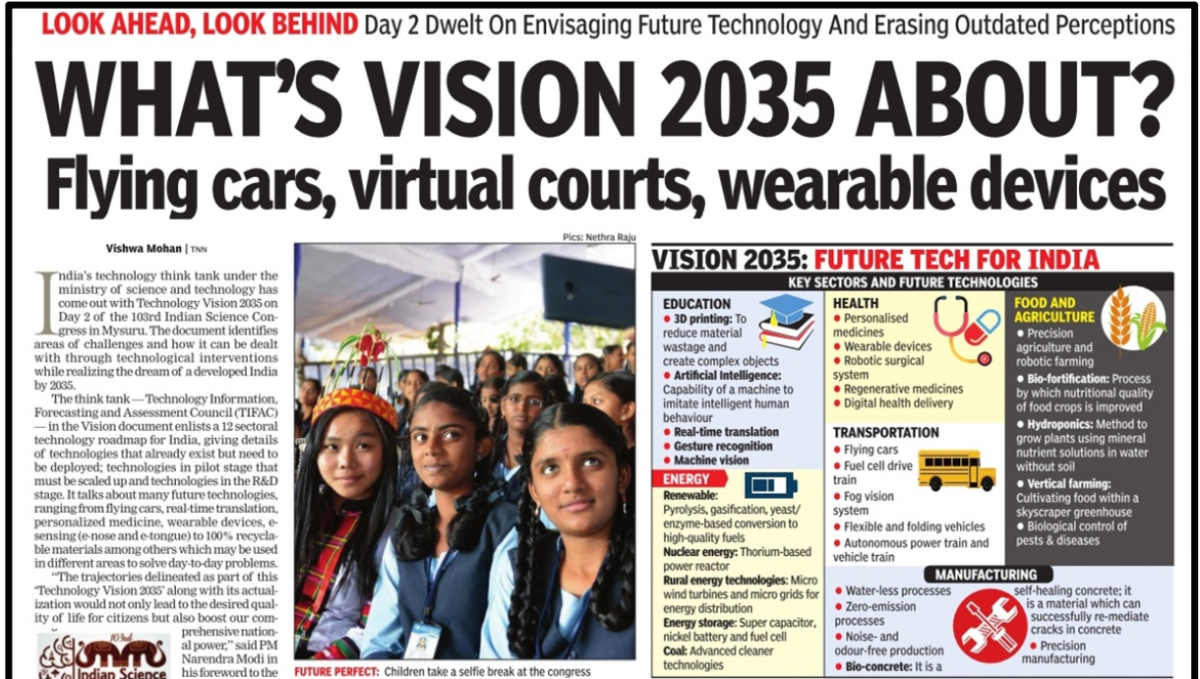
Continue reading “Prof Prabhat Ranjan Listed Among “Visionaries of India” by Outlook Magazine”The study of the impact of the Technology Vision 2035 document is an ongoing process and based on this mid-course correction in strategy is important for the country to move ahead. We have seen good action and progress in certain areas e.g. Waterways. However healthcare sector is still lagging and going by the current trend, we would not achieve the targets set by TV2035. Frequently, authorities responsible for these set a lower target for themselves that does not require a major effort!
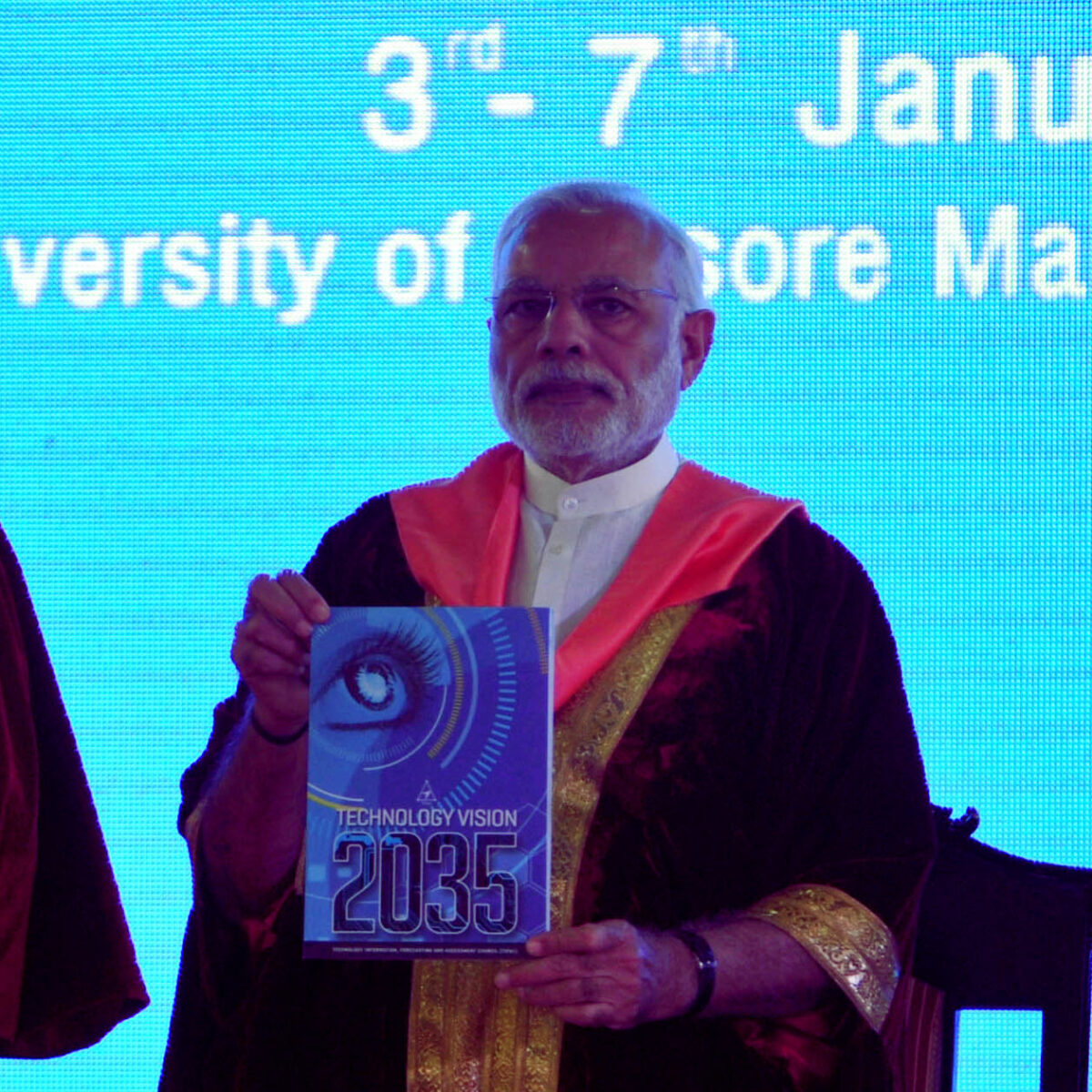
After Hon’ble PM launched Technology Vision 2035 on the morning of Jan 3, 2016 (See my blog Making and Launching of Technology Vision 2035), our focus shifted to its impact on the future of India. In that blog, I mentioned that “In the very first meeting on TV2035, I emphasized the importance of being able to communicate the document among citizens at large and policymakers, in particular. I mentioned multiple means of communication that are relevant today: (1) Print Media (2) Electronic Media (3) Social Media (4) the Internet (5) Workshops etc. Each one of these needed their own way of providing information from the document.”
Continue reading “Technology Vision 2035: Post Launch Activities and Impact”It is 5 years since launch of Technology Vision 2035 by PM on Jan 3, 2016. This series of blog is an attempt to remember the activitiees that happened before and after the launch. We plan to form a citizen centric intiative “Foundation 2035” to keep track of India’s progress with respect to TV2035. Contact me, if you are interested.
TIFAC (Technology Information, Forecasting and Assessment Council) is an autonomous body of Dept of Science and Technology(DST), Govt of India based in Delhi. It was conceptualized in 1986 as Technology Think Tank of India by the then planning commission(converted to NITI Aayog few years ago). While giving approval to the formation of TIFAC, it was moved to DST by cabinet. It started functioning in DST, first as a group and in 1988, it became an autonomous body with Dr Y S Rajan as its first executive director(ED), who was also a scientist in DST. The group in DST continued to work in TIFAC even after it came into existence as a separate entity. For some time, it operated out of a temporary building in DST premises(which still exists and is called Old TIFAC bldg) then to a hotel next door and moved to a building inside IIT Delhi campus which is shared between TIFAC and IIT Delhi Dept of Management Studies.
Continue reading “Making and Launching of Technology Vision 2035”