
If there is one place where I would say plainly that Technology Vision 2035 will not be met, it is health. I have said so before and the numbers have not improved since.
The medical sciences and health care roadmap was among the most quantitatively explicit of the twelve. It set out six figures with baselines and 2035 targets: life expectancy, maternal mortality, under-five mortality, total health spending, out-of-pocket spending and health worker density. That specificity is to the roadmap's credit. It is also why the sector can be graded harder than any other.
A decline that stopped
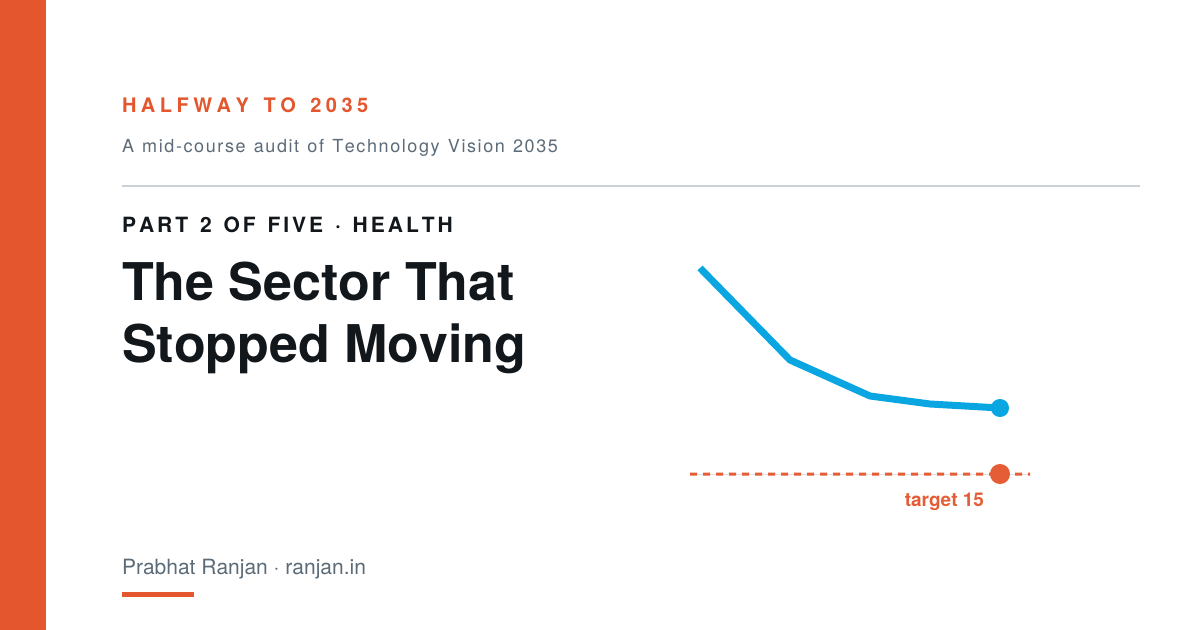
India cut maternal mortality from 212 to 88 per 100,000 live births in a little over a decade — one of the fastest declines recorded anywhere. Then it stopped. The three most recent Sample Registration System bulletins read 88, 88 and 87.
Our roadmap target was 15 per 100,000. At the pace of the last three bulletins, 2035 arrives at about 75. We do not reach 15 by 2035; on that trajectory we do not reach it this century.
I want to be careful about what this does and does not show. It is not a technology failure. Nothing in the roadmap's technology list — personalised medicine, digital health delivery, robotic surgical systems, controlled drug delivery — is the binding constraint on a safe delivery in a district where the constraint is a functioning referral chain at two in the morning. The early gains came from institutional delivery and immunisation drives, which are logistics. Those gains have been fully harvested. What remains is harder, and no roadmap of ours addresses it, because we were writing a technology document and the residual problem is not primarily technological.
Under-five mortality tells a gentler version of the same story: 53 per 1,000 in the roadmap's 2013 baseline, 31 by 2021, against a 2035 target of 6.
The number we could not agree on
Here is something I would rather not have found.
The medical sciences roadmap projected life expectancy reaching 72 years by 2035, up from 66 in 2013. The vision document, on printed page 55, said it "would have to be pushed upwards to 80 years at birth."
Two parts of the same publication, released together, eight years apart on the same indicator. Nobody reconciled them, and I include myself in that. Against the roadmap's 72 we are essentially there already. Against the vision's 80 we have covered under a third of the distance.
This is not pedantry about a stray number. The roadmap was making a projection — the trend line drawn forward with some optimism. The vision was making a demand — a statement about the country we wanted. Both are legitimate things for a document to contain. Printing them in the same typeface, in the same launch, without saying which is which, is not. A reader cannot audit what they cannot classify, and a decade later I cannot honestly tell you which number the exercise meant.
Spending less, not more
The roadmap projected total health spending rising from 4.0 per cent of GDP in 2013 to 5.7 per cent by 2035. The National Health Accounts put total health expenditure at 3.37 per cent of GDP in 2022-23.
That is a smaller share of a much larger economy. Whatever the merits of the argument that efficiency has improved, the indicator the roadmap chose has moved backwards from the baseline the roadmap set. It belongs in the reversing band and I have put it there.
The one genuine bright spot in the health numbers sits right next to it. Out-of-pocket expenditure — the share of health spending that comes straight from a household's pocket at the point of illness — has fallen from 64.2 per cent in 2013-14 to 43.4 per cent in 2022-23. The roadmap wanted 30 per cent by 2035. That is real progress on the indicator that matters most to a family facing a hospital bill, even if it is still fractionally behind the clock.
The first Grand Challenge
We chose, out of ten Grand Challenges, to put nutritional security and the elimination of female and child anaemia first. We wrote that over half of Indian women of reproductive age were chronically anaemic and that the trend was worsening.
It has continued to worsen. Prevalence rose from 53 per cent in NFHS-4 to 57 per cent in NFHS-5.
I do not think there is a way to present this as anything other than what it is. We identified the problem correctly, ranked it first, described the combination of public health and nutrition measures needed to reverse it, and the number went the wrong way. If a vision document's function is to direct attention, this is the clearest case in the whole exercise of attention having been directed and nothing having followed.
There is a habit here worth naming plainly, and it is not confined to health. Departments responsible for a target frequently adopt a softer one for themselves — comfortably reachable, achievable without much disruption — and then report against that instead. A vision document has no defence against this. Only citizens reading it do.
Next: milk, water and electrons — the things we counted, and the things that arrived.
Prabhat Ranjan was Executive Director of TIFAC through the preparation and launch of Technology Vision 2035.
Baselines and targets: Technoscape roadmap 2 (Medical Sciences and Health Care) and Technology Vision 2035, printed page 55. Current figures: SRS Special Bulletins on Maternal Mortality; SRS Report 2021; National Health Accounts Estimates 2022-23; NFHS-4 and NFHS-5.