Prof. Prabhat Ranjan CEO and Co-founder of a nuclear fusion company called ASPL Fusion. He is former Vice Chancellor of D Y Patil International University, Akurdi, Pune
The Purple Frog spends almost the whole year underground and surfaces for two weeks to mate, which makes sound the only way to study it. Where the wildlife work went next – acoustic sensing, poacher detection, a coral reef proposal that was not funded – and what the whole exercise taught me about asking the right question.
This is the last of three posts about the wildlife tracking work done at DA-IICT between 2006 and 2013, in collaboration with the Wildlife Institute of India, Dehradun. The first part described how the work began; the second described the three systems we built – wildCENSE, a GPS collar whose data travels from animal to animal instead of by satellite; tigerCENSE, a camera trap rebuilt as a single wireless node with an infrared flash and no shutter sound; and turtleCENSE, which located an animal too small to carry a GPS receiver by measuring the signal strength of its beacon at a grid of fixed stations.
This part is about where those ideas went next, and what the whole exercise taught me.
A collar that avoids the satellite link by letting the animals carry each other’s data. A camera trap rebuilt as a single node with an infrared flash, no shutter sound and a 250 millisecond response. And a hill turtle under 500 grams, which ruled out GPS altogether. What each of the three systems demanded, and where one of them defeated us.
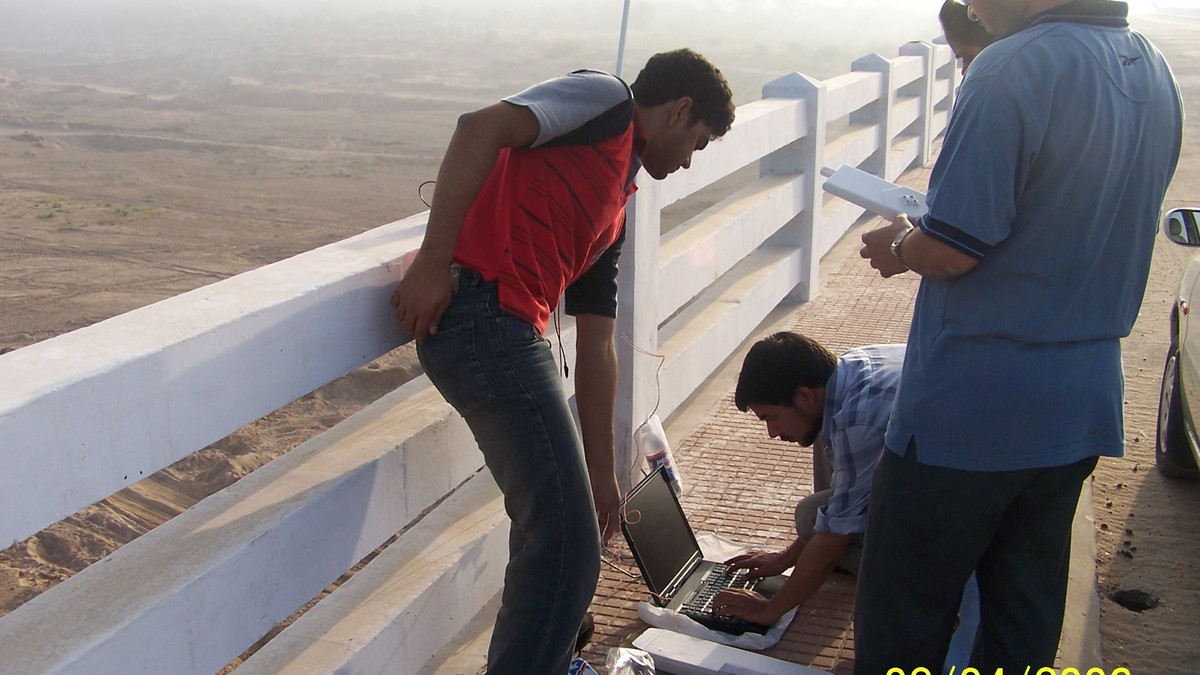
This is the second of three posts about the wildlife tracking work we did at DA-IICT between 2006 and 2013, in collaboration with the Wildlife Institute of India, Dehradun. In the first part I described how a fusion physicist came to be working on wireless sensor networks at all, how a lecture on the Zebranet project led to a visit to WII, and how one question asked in a room full of wildlife scientists produced twelve project ideas of which three were taken up. It also covered the first hand-wired prototype and the months we spent testing it on the bed of the Sabarmati river.
The three projects were deliberately chosen not to overlap: a GPS based collar for medium to large animals, aimed finally at the Barasingha (Swamp Deer); an image sensor network to photograph tigers along their trails; and a way of tracking small hill turtles inside the WII campus, where a GPS receiver could not be used at all. We called them wildCENSE, tigerCENSE and turtleCENSE. This part is about what each of them turned out to demand.
In 2006 I was teaching a sensor network course and discussed the Zebranet project in class. The team behind it had started with almost no experience, which raised an obvious question: if they could start from zero, why could we not? This is how the wildlife tracking work at DA-IICT began, and where it was first tested.
My foray into wildlife tracking (Part 1 of 3)
I moved to Dhirubhai Ambani Institute of Information and Communication Technology (DA-IICT), Gandhinagar in 2002 from the Institute for Plasma Research, Gandhinagar as a Professor. I started developing a new area of research while still trying to continue to work on Nuclear Fusion. Given the nature of courses in DA-IICT, I started to look at robotics as an area that could also be used for remote handling needs in a fusion reactor. As I started looking at published research work in robotics, I got interested in the concept of a Group of Robots that could communicate with each other and synchronize a task that was not possible by an individual robot. From here I eventually landed up in the area of Wireless Sensor Networks (WSN) which was in the early stages of development at that time.
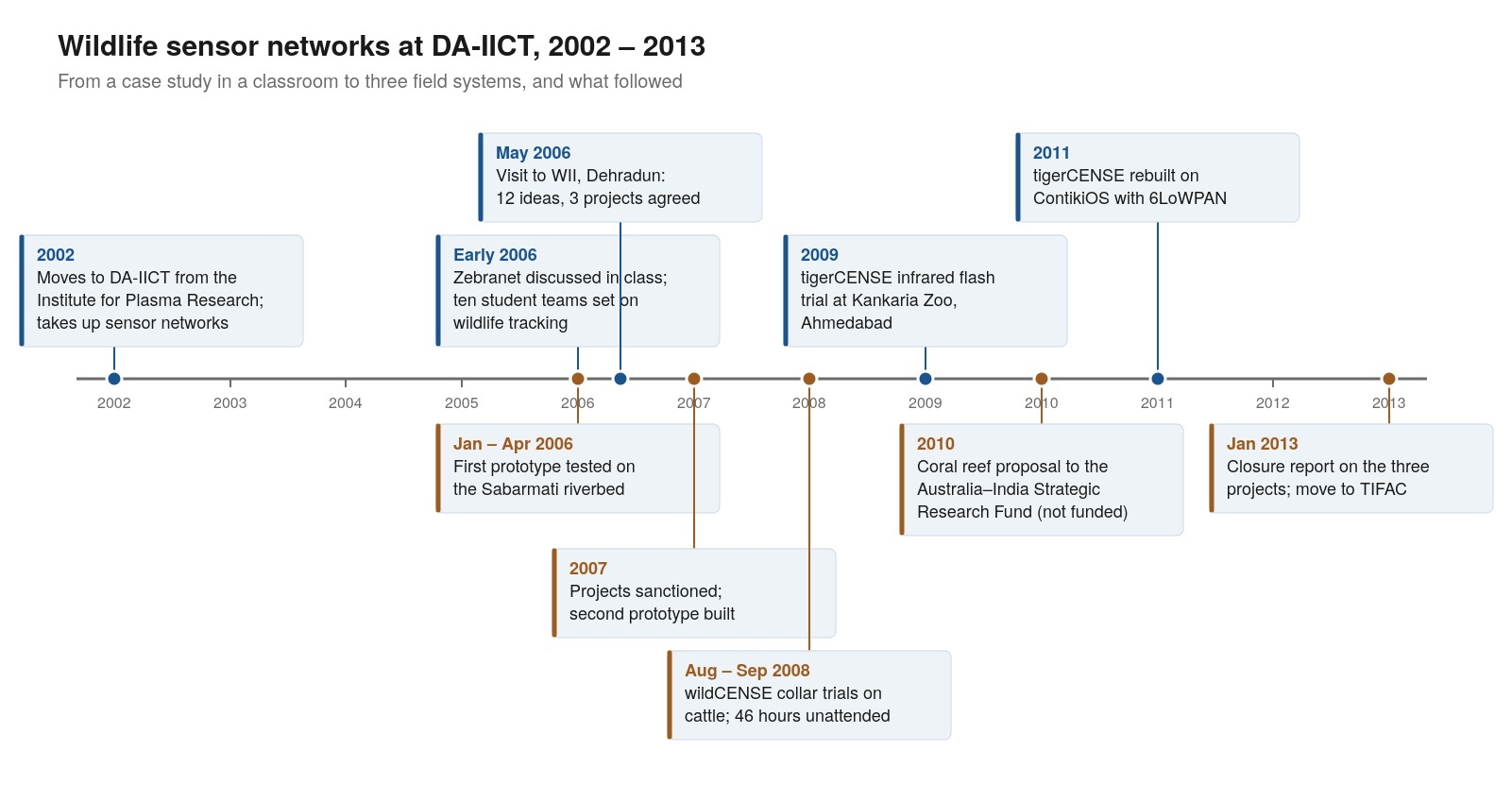
The whole arc in one picture – from a case study discussed in a classroom to the closure report of January 2013.
As DA-IICT was also in its infancy, I planned out a strategy to develop a sequence of courses that would prepare students to participate in WSN-related work in the coming years. These courses started from Master’s level and slowly moved to UG level. Eventually, they stabilized as Embedded Hardware Design (EHD), Embedded Systems Programming (ESP), Sensor Network Devices (SND), and Sensor Network Systems (SNS).
I used to always start teaching a course with a few case studies to motivate the students toward certain application areas that were already possible or may become possible in the future. In 2006, as I was teaching a Sensor Network course, I discussed two examples in detail where the concept of WSN was used. One of these was the Great Duck Island (GDI) project of Berkeley and the other one was the Zebranet project of Princeton.
While going through the Zebranet project, I realized that the team working on the project had nearly zero experience with this kind of project. That triggered a thought in my mind – if they can start from zero why can’t we do it too and take up similar projects? As most of my courses required students to do projects, I asked 10 teams to take up projects related to wildlife tracking. With my experience, I knew that only 3-4 teams would do some serious work but that would create enough base to discuss with real users.
I began my research life on a magnetic mirror at Berkeley, then spent sixteen years making India’s first-generation tokamaks work. Here is why ASPL Fusion has chosen the magnetic mirror over the tokamak and the stellarator, and what the mirror still does not give us.
Fusion is a field of believers, and I have believed in more than one machine. I spent a large part of my working life building tokamaks. Today the company I lead is building magnetic mirrors. This post explains that shift, and why I think it is the right choice for ASPL Fusion and for India.
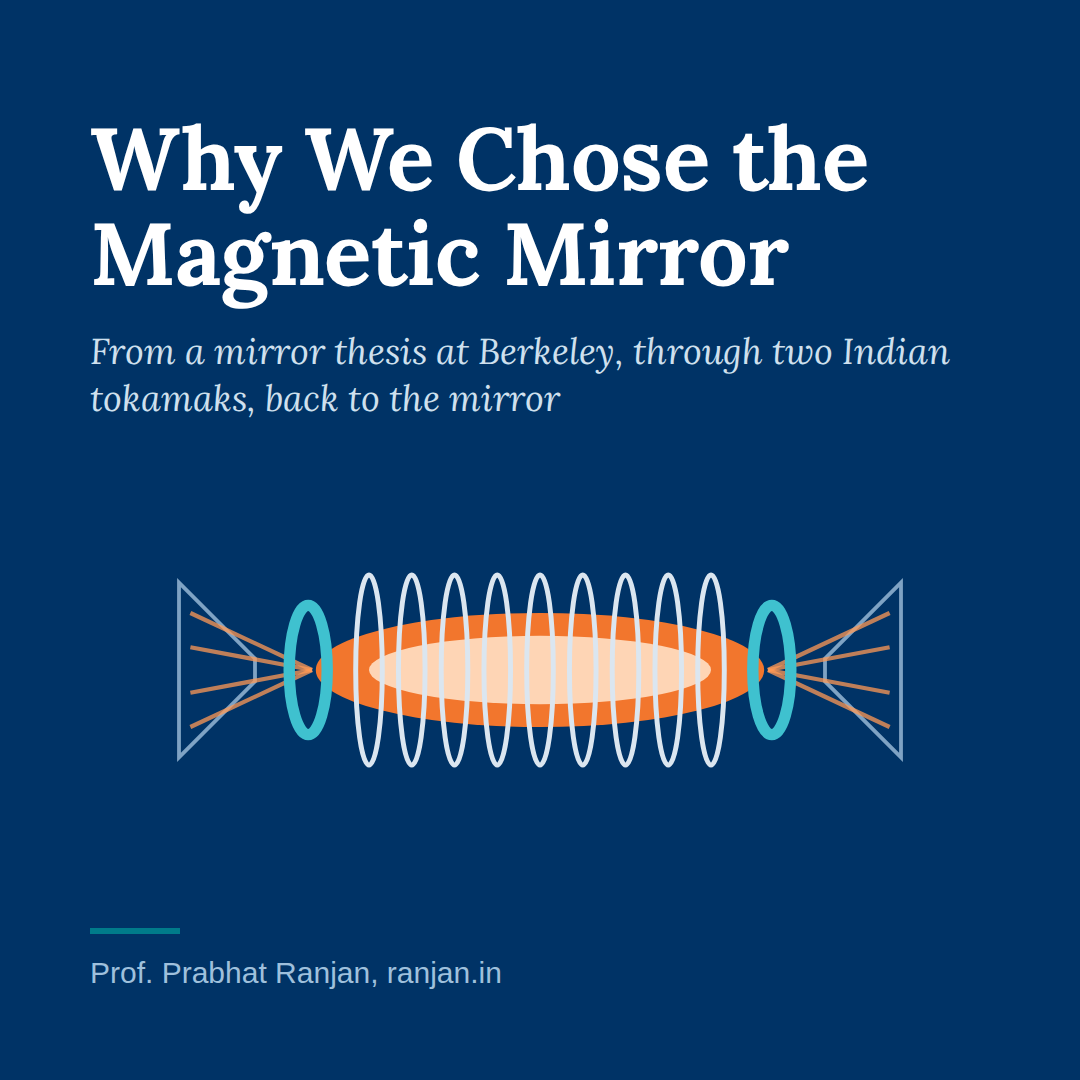
Tokamaks, stellarators and magnetic mirrors are all magnetic-confinement devices. They differ in one basic decision: how the magnetic field lines are closed. A tokamak bends the field into a doughnut and drives a large current through the plasma to complete the magnetic cage. A stellarator also uses a doughnut, but twists the field with intricate three-dimensional external coils, so no plasma current is needed. A magnetic mirror does not close the field at all. It is a straight tube of plasma held between two regions of stronger field, built from simple circular coils, which reflect most particles back towards the centre.
A foresight exercise that missed the technology which changed everything, while cataloguing several that changed nothing, has a selection problem rather than an information problem.
In 2014 we wrote that schools, colleges and universities as currently constituted would be redundant by 2035. Nine years from that deadline, here is what the same chapter said about teachers — and the one recommendation in it that India has ignored.
What Technology Vision 2035 wrote about teachers, and what we have done about it since
Let me begin with a sentence I helped write, which is not a comfortable one to read out on Teachers’ Day.
In 2015, at TIFAC, we prepared Technology Vision 2035 for the country. It set out twelve prerogatives that every Indian should be able to count on by that year, and the sixth of them was quality education, livelihood and creative opportunities. The chapter opens with this: “Schools, colleges and universities as currently constituted will be redundant in 2035.”