India is writing the rulebook for fusion

Two draft instruments will decide, far more concretely than any policy statement, whether fusion energy has a path in India. Having read them line by line, I want to explain what I found — because the most important issue turns on one word.

On 14 August the Department of Atomic Energy and the Atomic Energy Regulatory Board placed two draft instruments in the public domain: the SHANTI Rules, 2026 and the SHANTI Regulations, 2026, made under the Act passed last year. Comments close on 4 September. Anyone may file them.

These are not glamorous documents. They are long, technical, and written in the flat register that subordinate legislation demands. But they will determine, far more concretely than any policy statement, whether fusion energy has a path in India. I have spent the past fortnight reading them line by line, and I want to explain what I found — because the single most important issue turns on one word.

A note on where I stand, before you read any further. I am Co-founder and Chief Executive Officer of ASPL Fusion Pvt. Ltd., a private company that would be a potential applicant under the rules I am about to discuss. I also chair the committee constituted by the Central Electricity Authority to prepare a national roadmap for fusion-based power generation. What follows is written in my personal and professional capacity and not on behalf of that committee. Some of what I argue for would benefit companies like mine. I have tried throughout to argue on grounds that are neutral as between technologies and as between companies, and you should judge whether I have succeeded.

Continue reading “India is writing the rulebook for fusion”

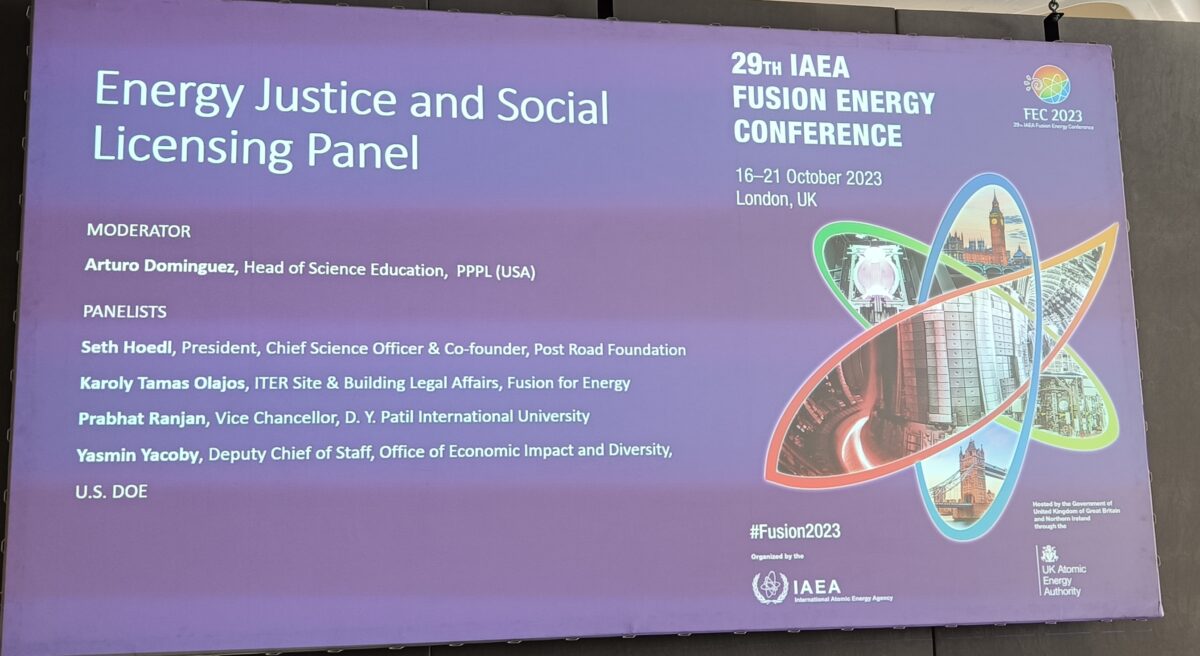
29th IAEA Fusion Energy Conference, London -Energy Justice and Social Licensing Discussion

Prof Prabhat Ranjan’s talk at 29th IAEA Fusion Energy Conference, London on “Energy Justice and Social Licensing”

Video of the talk

Transcript of the talk


ARTURO(Moderator):

So I’ll move us to a global context. You gave a really great introduction of in the US what’s being done.

And I’d like to pass this next question to Prabhat. Prabhat, as the fusion ecosystem moved towards the fusion pilot plants and commercialization, what concerns do you see regarding the global south’s role in the process? And what opportunities do you envision in this process?

PRABHAT RANJAN(Panelist):

Thank you. Global South is not only a geographical concept. It’s also an economic concept. And that economic concept keeps changing. And the countries that are part of the global south are not really fixed. Today, if I take from Steve’s talk, he talked about the industrial revolution. If I see economy before that, from 1st AD to 1800 AD, it was India and China, which was producing maximum 20 % to 30 % of global manufacturing was happening in India and China. It was industrial revolution which changed the games. And things moved to global north at that time. And the countries like India became poorer in that process.

Continue reading “29th IAEA Fusion Energy Conference, London -Energy Justice and Social Licensing Discussion”
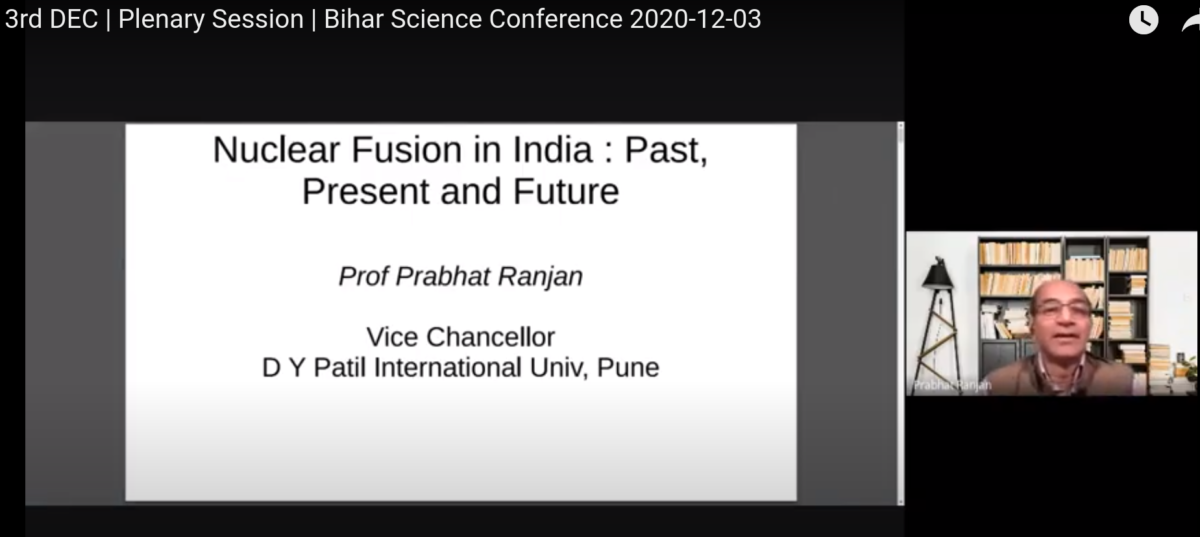
Nuclear Fusion in India : Past, Present and Future

This is video of a plenary talk that was given at Bihar Science Conference on Dec 3, 2020 held online. Talk gives overall progress of nuclear fusion in last 4 decades in India and where we need to go. The talk also makes historic announcement regarding a privately funded Nuclear Fusion project in India code named – Project Sanlayan. Here is the link to video – talk starts after 3:00 minutes.

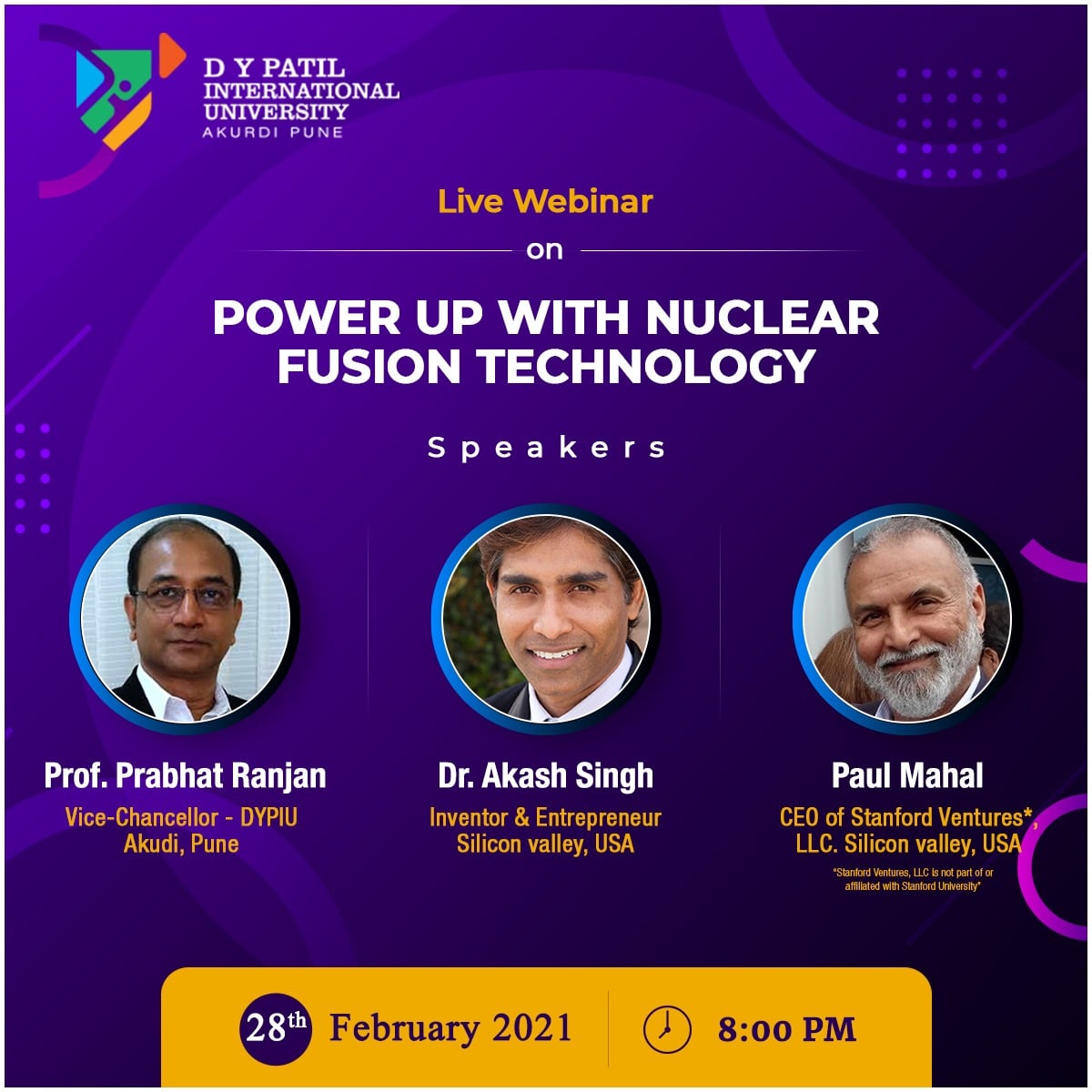
DYPIU : National Science Day discussion on Nuclear Fusion

Prof Prabhat Ranjan, Vice Chancellor, D Y Patil International University, Akurdi, Pune leads a discussion on use of Nuclear Fusion for a clean energy for world. This was organized on the occasion of National Science Day (Feb 28, 2021). He is joined by Dr Akash Singh, Inventor and Investor and Mr Paul Mahal, a semiconductor expert and CEO, Stanford Ventures – both based out of Silicon Valley, USA.