What I Would Tell the 2047 Committee
Four parts of scorekeeping earn the right to one part of advice. And there is somewhere for it to go: the successor exercise is already running.
Prof. Prabhat Ranjan CEO and Co-founder of a nuclear fusion company called ASPL Fusion. He is former Vice Chancellor of D Y Patil International University, Akurdi, Pune

Four parts of scorekeeping earn the right to one part of advice. And there is somewhere for it to go: the successor exercise is already running.
A foresight exercise that missed the technology which changed everything, while cataloguing several that changed nothing, has a selection problem rather than an information problem.
In 2014 we wrote that schools, colleges and universities as currently constituted would be redundant by 2035. Nine years from that deadline, here is what the same chapter said about teachers — and the one recommendation in it that India has ignored.
What Technology Vision 2035 wrote about teachers, and what we have done about it since
Let me begin with a sentence I helped write, which is not a comfortable one to read out on Teachers’ Day.
In 2015, at TIFAC, we prepared Technology Vision 2035 for the country. It set out twelve prerogatives that every Indian should be able to count on by that year, and the sixth of them was quality education, livelihood and creative opportunities. The chapter opens with this: “Schools, colleges and universities as currently constituted will be redundant in 2035.”
There are nine years left on that clock.
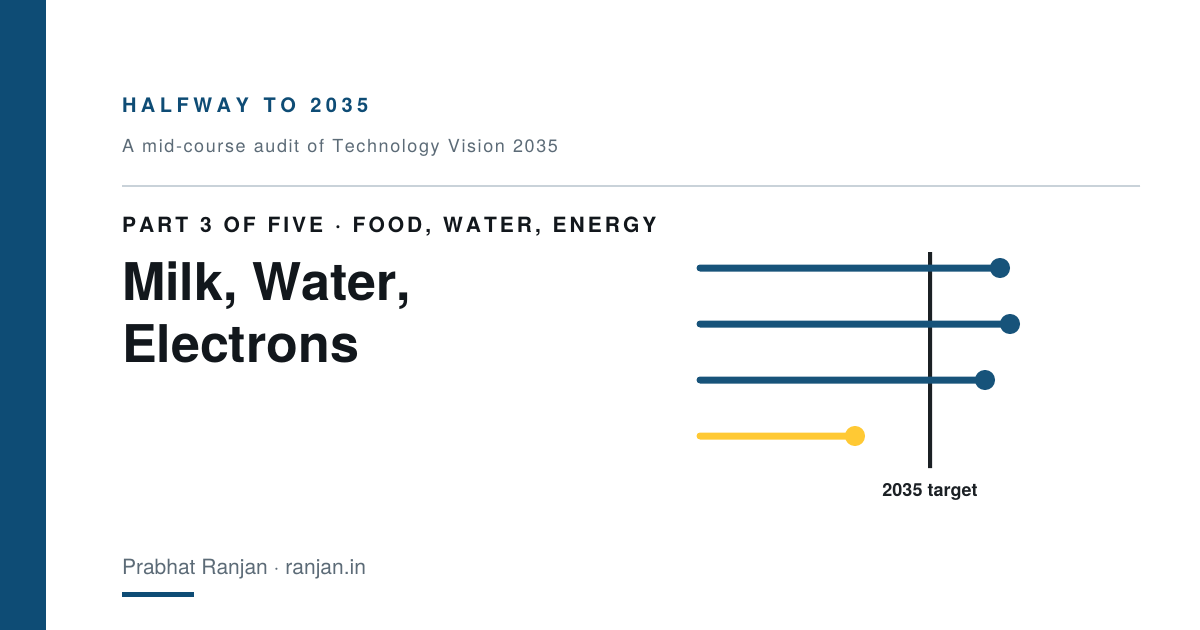
Continue reading “We Said Universities Would Be Redundant. We Never Said That About Teachers!”Milk, water and electrons look like three different
stories. They are one story told three times: the country builds ahead of schedule, and what the citizen receives lags behind.
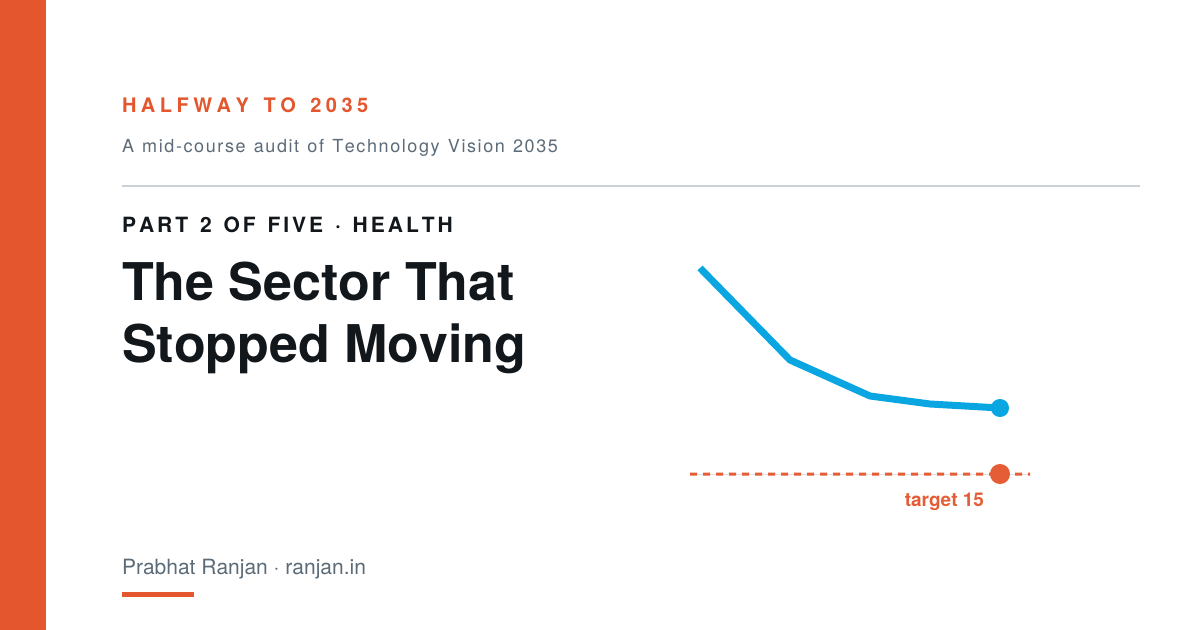
The medical sciences roadmap was the most quantitatively explicit of the twelve. That is to its credit, and it is why the sector can be graded harder than any other.
Technology Vision 2035 named twelve prerogatives, ten Grand Challenges and hard figures with a date attached. Ten years and seven months of the twenty are gone.
This is the audit, done in public, against our own numbers.
India’s electricity demand will nearly quadruple by 2047. Solar and wind cannot carry that load alone. The time to build the next generation of baseload is not 2040 — it is today and why fusion must be a strong part of it.
India’s electricity demand will nearly quadruple by 2047. Solar and wind cannot carry that load alone. The time to build the next generation of baseload is not 2040 — it is today.
Disclosure: The author is co-founder of ASPL Fusion, a private Indian fusion company. This article presents an industry perspective on national energy policy. The policy arguments are grounded in publicly available data; the ASPL programme description in Section 5 is provided as a concrete illustration of what a domestic fusion development path can look like in practice.
708 GW peak demand and 2,100 GW total capacity needed by 2047 — the equivalent of building a new US power grid from scratch.
Intermittent renewables alone cannot provide firm power — grid stability requires large-scale dispatchable baseload even with abundant storage.
Fusion now has serious private capital behind it: Microsoft, Google, and OpenAI are structuring power purchase agreements with fusion companies. India risks being a technology importer.
Three budget-cycle asks for 2026: fusion in National Energy Plan · dedicated component development fund · AERB regulatory engagement mandate.
India’s Central Electricity Authority projects peak power demand reaching 708 GW by 2047 — four times today’s installed capacity. Meeting it requires 2,100 GW of generation: close to the entire current installed capacity of the US and EU combined. That is the scale of infrastructure build India must manage across the next two decades.