
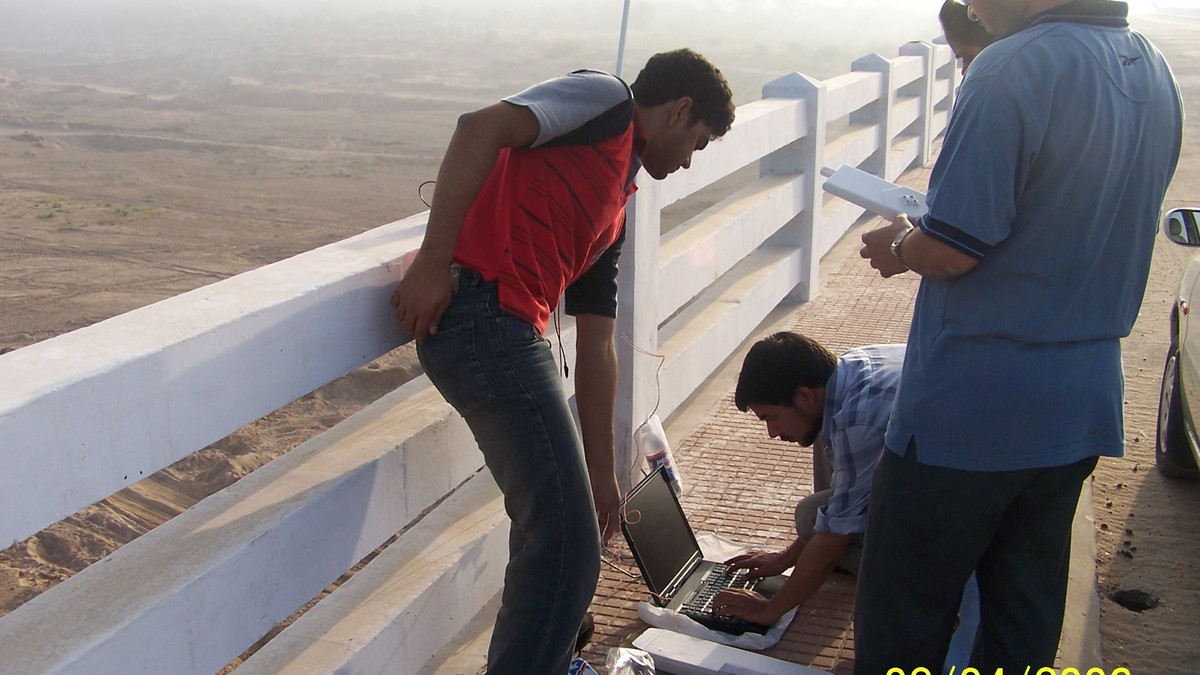
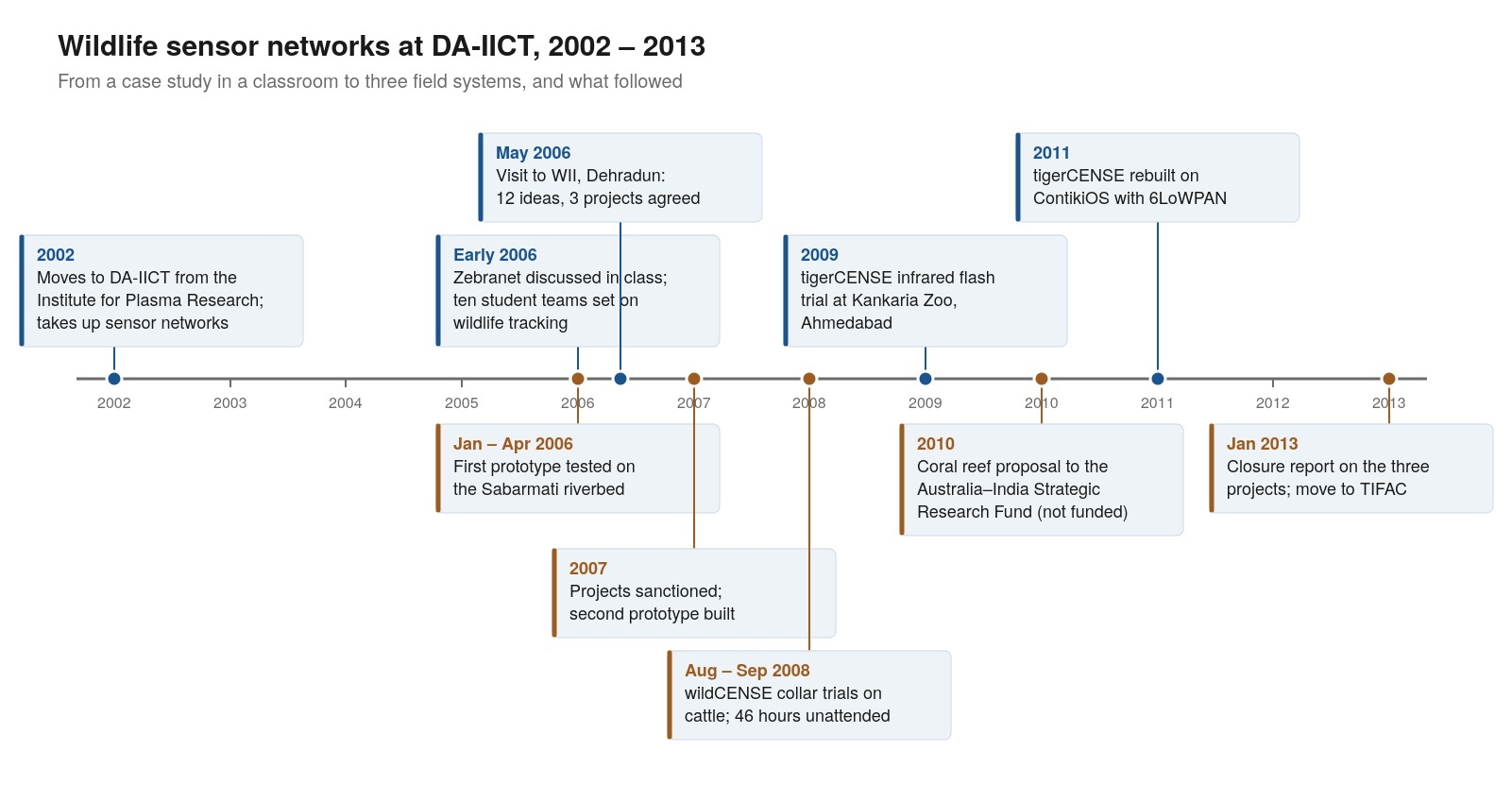
I moved to Dhirubhai Ambani Institute of Information and Communication Technology (DA-IICT), Gandhinagar in 2002 from the Institute for Plasma Research, Gandhinagar as a Professor. I started developing a new area of research while still trying to continue to work on Nuclear Fusion. Given the nature of courses in DA-IICT, I started to look at robotics as an area that could also be used for remote handling needs in a fusion reactor. As I started looking at published research work in robotics, I got interested in the concept of a Group of Robots that could communicate with each other and synchronize a task that was not possible by an individual robot. From here I eventually landed up in the area of Wireless Sensor Networks (WSN) which was in the early stages of development at that time.
As DA-IICT was also in its infancy, I planned out a strategy to develop a sequence of courses that would prepare students to participate in WSN-related work in the coming years. These courses started from Master’s level and slowly moved to UG level. Eventually, they stabilized as Embedded Hardware Design (EHD), Embedded Systems Programming (ESP), Sensor Network Devices (SND), and Sensor Network Systems (SNS).
I used to always start teaching a course with a few case studies to motivate the students toward certain application areas that were already possible or may become possible in the future. In 2006, as I was teaching a Sensor Network course, I discussed two examples in detail where the concept of WSN was used. One of these was the Great Duck Island (GDI) project of Berkeley and the other one was the Zebranet project of Princeton.
While going through the Zebranet project, I realized that the team working on the project had nearly zero experience with this kind of project. That triggered a thought in my mind – if they can start from zero why can’t we do it too and take up similar projects? As most of my courses required students to do projects, I asked 10 teams to take up projects related to wildlife tracking. With my experience, I knew that only 3-4 teams would do some serious work but that would create enough base to discuss with real users.
Continue reading