
This is the last of three posts about the wildlife tracking work done at DA-IICT between 2006 and 2013, in collaboration with the Wildlife Institute of India, Dehradun. The first part described how the work began; the second described the three systems we built – wildCENSE, a GPS collar whose data travels from animal to animal instead of by satellite; tigerCENSE, a camera trap rebuilt as a single wireless node with an infrared flash and no shutter sound; and turtleCENSE, which located an animal too small to carry a GPS receiver by measuring the signal strength of its beacon at a grid of fixed stations.
This part is about where those ideas went next, and what the whole exercise taught me.
FrogCense: listening instead of looking
The three projects had between them covered a collar, a camera and a radio beacon. There remained one channel we had not used at all – sound. And there was an animal that could be studied by no other means.
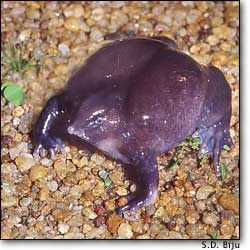
The Purple Frog was discovered only in October 2003, in the Western Ghats of south India, and was found to be unique to that region. It spends almost the entire year underground and comes to the surface for roughly two weeks during the monsoon, to mate. That reclusive habit is precisely why biologists had missed it for so long. You cannot collar it, you cannot photograph it on a trail, and by the time you have organised a field team it has gone back underground. But during those two weeks it calls.
So we started work on an acoustic sensor network. The difficulty here is not the microphone, it is the data. Sound recorded continuously through a monsoon is an enormous quantity of information, and no wireless sensor node can transmit it, nor can anyone usefully listen to it afterwards. The node therefore has to do the recognition itself, at the point of capture, and send only what matters. We were building a low-cost node with dual voice recording chips and a floating point coprocessor, so that one chip could keep recording while the other’s contents were being processed – recognition without dropping any audio – and only a compressed sample of an identified call would be transmitted, along with its time-stamp and location.
By 2012 this project was about midway. The same technique generalises far beyond one frog: the arrival dates of migratory birds, for instance, are exactly the kind of thing a network of listening nodes could record year after year without anyone standing in a field at dawn.
Laxman Rekha, and a coral reef proposal that got away
Two other directions grew out of the same work. The first came from a question the researchers themselves kept returning to: the technology that detects an animal crossing a line can equally detect a human crossing one. We called this Laxman Rekha – poacher intrusion detection. Camera traps had already, on occasion, photographed poaching parties, and while the animal in that particular case could not be saved, the photographs led to arrests and convictions. A network that can raise an alarm in real time rather than weeks later is a very different proposition, and it costs almost nothing extra once the nodes are already on the trail.
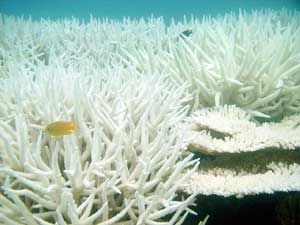
The second went underwater. Rising sea temperature bleaches coral, and a reef is exactly the kind of system that rewards continuous measurement – temperature, salinity, pH, light, pollutant concentrations, recorded not at one place on one day but at many places and several depths, month after month. The traditional method is to send people out in a boat, take samples, and analyse them in a laboratory afterwards, which is expensive and, for remote reefs, largely impractical. What we wanted to lay over a reef was what the proposal called a digital skin.
In 2010 we submitted a proposal titled “Coral Reef Monitoring using Distributed Sensor Networks” to the Australia-India Strategic Research Fund, as a DST-DIISR joint project of 36 months. I was the Indian Principal Investigator, with Prof. Sanjay Srivastava of DA-IICT as Co-PI and Prof. Krishna Sivalingam of IIT Madras in the team. The Australian Principal Investigator was Prof. Marimuthu Palaniswami of the University of Melbourne, along with colleagues from the University of Queensland and James Cook University. Four sites were identified for testbeds – the Great Barrier Reef and Moreton Bay in Australia, Lakshadweep and the Gulf of Kutch in India – two of them chosen to measure direct human impact and two to measure the effects of global climate change.
The engineering problems were quite unlike anything we had faced on land. A sensor mote that communicates over 30 metres in a field manages about 10 metres near water. The nodes sit on buoys, buoys move with the waves, and the antennas therefore keep losing line of sight with each other; worse, a node that has lost its link goes on searching for it and drains its battery in the process. Our answer was to put an accelerometer on the buoy, model the wave motion, and let the node work out its own window of opportunity for transmitting – schedule the communication around the sea instead of fighting it. Alongside that we proposed anomaly detection at the node itself, so that a network generating data continuously would tell a scientist when something had happened rather than merely accumulating numbers.
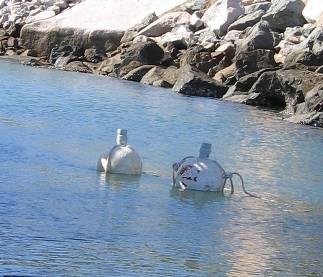
The proposal was not funded. I am recording it here all the same, because a research career is made up at least as much of these as of the projects that come through, and because nothing in the idea has aged. The buoy-mounted node, the sensor string hanging below it, scheduling transmission around wave dynamics, recognising the event at the node rather than shipping everything home – it is the same principle as the collar on a deer and the camera on a tiger trail. Put a small amount of intelligence where the phenomenon is, and bring back only what is worth bringing back.
What it added up to
Over about six years the group produced five conference papers – at WPMC 2007 in Jaipur, ISSNIP 2008 in Sydney, WCSN 2008 in Allahabad, REALWSN 2010 in Sri Lanka and WCSN 2011 in Panna – and I was invited to speak on this work at a number of places, including the Wildlife Telemetry Workshop at Dehradun in 2010 and an Indo-Canadian workshop organised by DRDO and SAMEER in 2011. Behind those papers sit some twenty B.Tech. project reports and a much longer list of students, several of whom have gone on to do serious work in sensor networks elsewhere in the world.
But the number I actually care about is a different one. Ten teams were asked to work on wildlife tracking in a course. Three or four did something serious. That was enough to walk into the Wildlife Institute of India with working hardware rather than a proposal, and everything else followed from that.
What I took away from it
The question is more important than the answer. Nothing in these three projects would have happened if that room in Dehradun had continued to give me incremental improvements to what they were already doing. Asking people to describe what they want while explicitly relieving them of the burden of knowing how it could be built is a technique I have used many times since, and it has never once failed to produce something I had not anticipated.
Design for the animal, not for the demonstration. Non-intrusiveness is not a feature to be added later – no visible flash, no click, no repeated human visits into the forest, no weight the animal has to carry for our convenience. Once you accept those as constraints, most of the design decisions make themselves.
Cost decides scale, and scale decides science. Avoiding the satellite link and building indigenously was not about saving money for its own sake. It was about the difference between instrumenting three animals and instrumenting thirty.
Trials on a cow are not a lesser form of trials on a deer. Every serious flaw in wildCENSE was found on a domestic animal in a field near the campus, at a stage when we could still walk up and take the device back.
And, finally, two communities that do not share a vocabulary can still work extremely well together, provided each is willing to state its problem plainly and let the other decide what is hard.
Where it went from here
We wrote a closure report on the three projects in January 2013. In April 2013 I moved to Delhi to head TIFAC, India’s technology think tank, and the wildlife work at DA-IICT wound down. In my larger account of my research journey – from Universe to Sun to Moon to Earth to Body to Brain – this is the chapter where the journey reached “Earth”, and it arrived there through sensor networks, having come to the Moon by the same route through the Chandrayaan-2 work. The same laboratory, the same students and very nearly the same hardware served both a lunar explorer and a tiger trail, which still strikes me as a rather good argument for building capability rather than devices.
If you would like to read the wider arc that this work sits inside, please see my blog: My Research Journey to Brain.
All the published papers and the student project reports from these projects are available online, and I am happy to share them with anyone who wants to take this work forward. The turtles, in particular, are still waiting.