
Fusion is a field of believers, and I have believed in more than one machine. I spent a large part of my working life building tokamaks. Today the company I lead is building magnetic mirrors. This post explains that shift, and why I think it is the right choice for ASPL Fusion and for India.
Tokamaks, stellarators and magnetic mirrors are all magnetic-confinement devices. They differ in one basic decision: how the magnetic field lines are closed. A tokamak bends the field into a doughnut and drives a large current through the plasma to complete the magnetic cage. A stellarator also uses a doughnut, but twists the field with intricate three-dimensional external coils, so no plasma current is needed. A magnetic mirror does not close the field at all. It is a straight tube of plasma held between two regions of stronger field, built from simple circular coils, which reflect most particles back towards the centre.

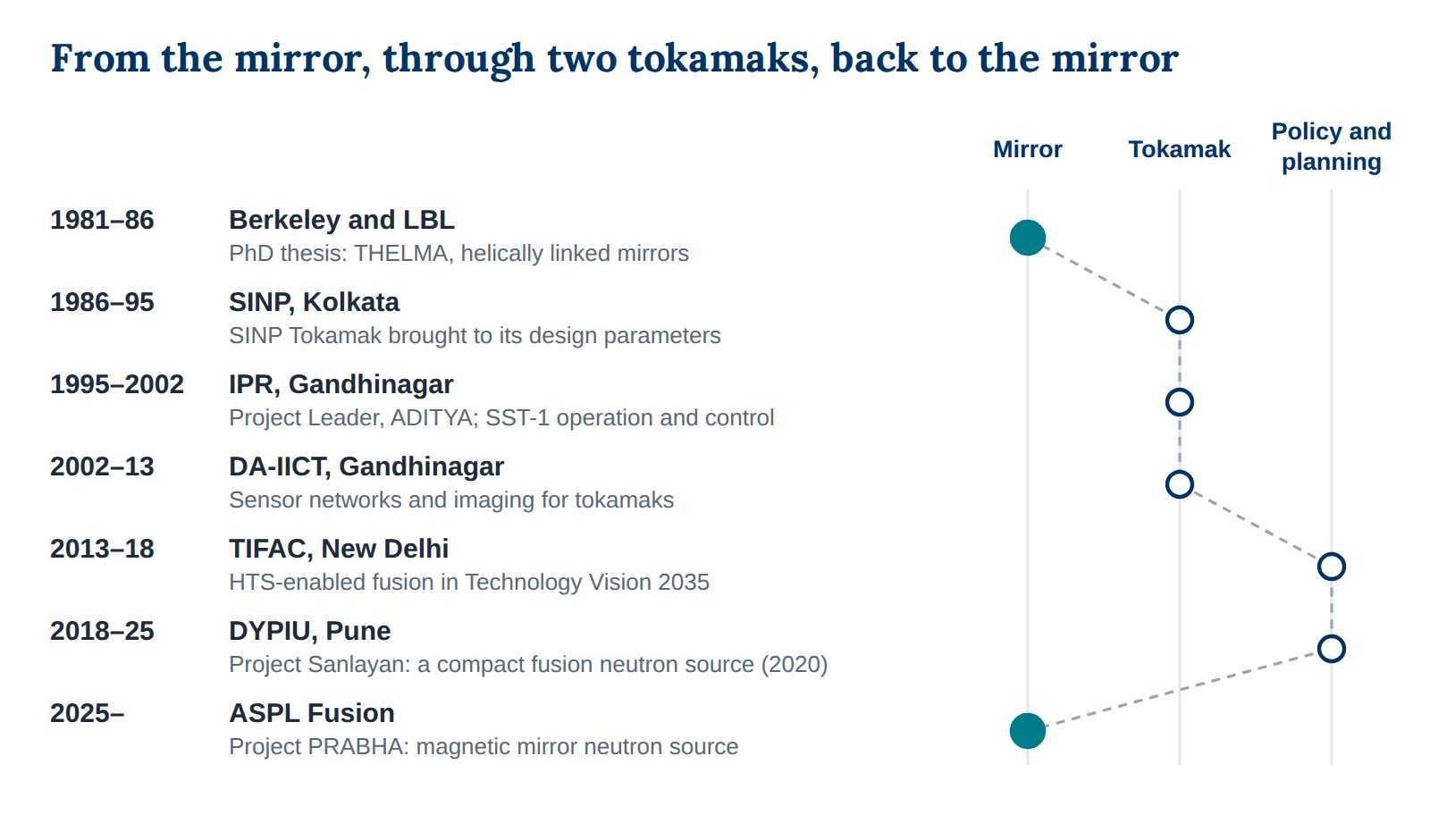
In September 1981, on the night I left India for Berkeley, I decided to give up astrophysics for fusion, so that I could serve the country better when I came back. My PhD thesis at Lawrence Berkeley Laboratory proposed THELMA, the Triangular Helically Linked Mirror Arrangement, a hybrid of the magnetic mirror and the stellarator. I completed it in 1986, the same year the United States finished its largest mirror experiment, MFTF-B, and then mothballed it without ever running it.

THELMA’s idea was to keep the mirror’s simple, straight, high-beta sections while closing their ends with helical links, so that particles leaving one mirror would enter the next instead of escaping. The twist in the links gave a rotational transform of about 310°, and the device was designed for steady-state operation. The thesis abstract opened with a line I still stand by: although tokamaks were nearing breakeven, many technical and economic hurdles remained, so there was no reason to give up on alternative schemes that might cross them more easily.
I came home that year, and for the next sixteen years I worked on tokamaks: first at the Saha Institute of Nuclear Physics in Kolkata, then at the Institute for Plasma Research in Gandhinagar. (I have told that story in more detail in My Contribution to Nuclear Fusion Technology.) So when I say that ASPL chose the mirror, I am saying it as someone who began with the mirror, spent most of his research life making tokamaks work, and has now come back to the mirror with that experience.
What sixteen years of tokamaks taught me
I had the privilege of helping bring both of India’s first-generation tokamaks to international standards. At SINP, between 1987 and 1993, we took the SINP Tokamak to its full design parameters of 75 kA and a 20 ms flat top. At IPR, where I was Project Leader of ADITYA from 1996 to 2002, its pulse length rose from 30 ms to about 220 ms, its current passed 110 kA, and its reproducibility went from 15% to 80–90%. I also led the Operation and Control Group of SST-1, our steady-state superconducting tokamak, and designed its distributed control system.
Those years were spent less on elegant physics than on making machines behave. Each problem left a lesson, and those lessons now shape what ASPL is building.
The plasma current is the machine’s weak point. When I joined IPR in 1995, ADITYA had been running for six years, but its plasma current crashed within the first 20–30 ms of every shot. Much of the work that followed was about keeping that current alive and under control. The tokamak’s confinement depends on a current that it is always at risk of losing.
Everything sits inside everything else. Around 1997–98, the insulation of ADITYA’s central solenoid, TR-1, failed. TR-1 is buried in the middle of the machine. The normal repair meant dismantling the tokamak for about two years. We found a way to extract, repair and reinstall it without significant disassembly, but the lesson stayed with me: in a torus, the most important components are the hardest to reach.
Coil geometry is unforgiving. ADITYA showed error fields of 30–40 G where there should have been none. My field calculations traced them to a coil built 107 cm long instead of the designed 100 cm, a change made for ease of manufacture. A few centimetres in one coil were enough to disturb the field.
Pulsed machines carry large forces. When a power supply safety system failed, the electromagnetic forces broke ADITYA’s restraining supports and threw out two large magnets. The design had underestimated those forces. Pulsed operation means repeated, heavy mechanical loads on the whole structure.
India can build what it needs, at a fraction of the price. The SINP Tokamak had no power supply to hold its current flat. I built a 200 kJ slow capacitor bank of nearly 1,300 electrolytic capacitors for ₹20 lakh, against a quotation of ₹1.5 crore from Toshiba. Most of the improvements to both machines were made in India, by small teams, with modest budgets.
None of this makes the tokamak a bad machine. Decades of work from JET to the machines now running in China, Korea and Europe have made it the best-understood fusion concept in the world, and India’s place in ITER rests on the foundation that ADITYA and SST-1 laid.
But the tokamak’s strength is also its burden. The current that completes its magnetic cage sets the density limit, can end in a disruption that dumps the stored energy into the walls in milliseconds, and usually makes the machine pulsed. On SST-1, the central question was how to keep a tokamak plasma running for long periods without the current misbehaving. It is a solvable problem, but it has to be solved continuously, every second the machine runs.
The stellarator answer, and its price
The stellarator removes the plasma current. Its twisted field comes entirely from external coils, so an optimised stellarator has no current-driven disruptions, no Greenwald density limit and a natural path to steady-state operation. Wendelstein 7-X in Germany has shown that this works, and Proxima Fusion’s CEO, Francesco Sciortino, has made the case well in his recent post on moving from tokamaks to stellarators. I agree with most of his diagnosis of the tokamak.
The price of the stellarator is geometry. Its coils are three-dimensional, non-planar shapes that must be designed by large-scale numerical optimisation and built to very tight tolerances. Wendelstein 7-X cost well over a billion euros. Modern computing and high-temperature superconductors (HTS) have made this far more tractable, but the stellarator still front-loads enormous complexity into design, manufacturing and assembly. It is still a closed torus, with the same nested maintenance problem as a tokamak.
I remember a single ADITYA coil, a few centimetres longer than designed, filling the vessel with error fields. A stellarator asks for dozens of complex three-dimensional coils, each held to tolerances far tighter than that. For a country with a deep, well-funded stellarator ecosystem, that may be the right trade. For a young private company in India, it asks us to begin with the hardest manufacturing problem in fusion.
Ironically, my own thesis was a mirror–stellarator hybrid. THELMA tried to combine the mirror’s simple linear sections with helical linking. Forty years on, I would keep the simplicity and leave the twist out.
The mirror: written off in 1986, back in the race
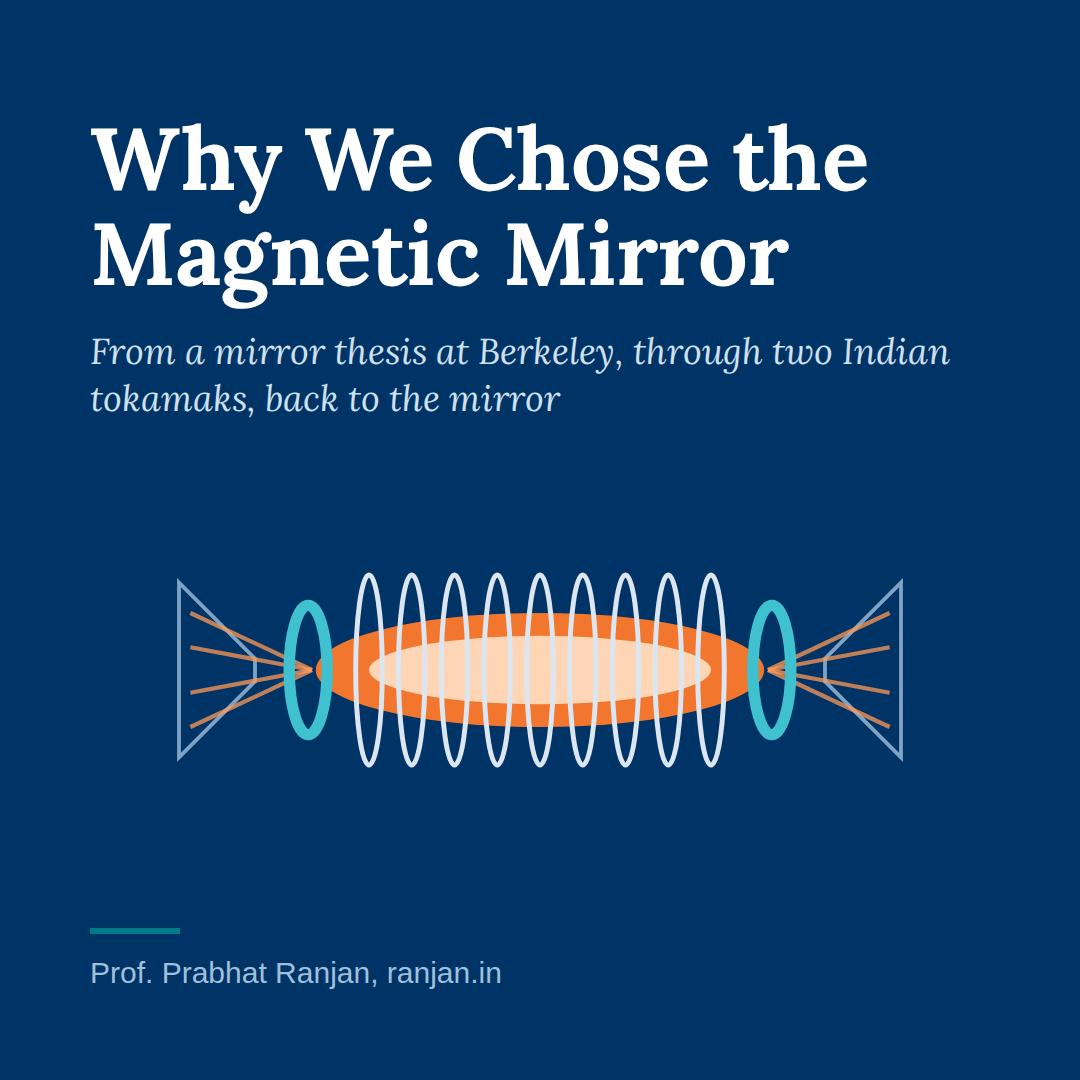
The magnetic mirror is the simplest magnetic bottle. A long solenoid of circular coils holds the plasma in a central cell; stronger coils at each end pinch the field, and charged particles moving mostly across the field are reflected back. There is no plasma current to sustain, so there are no current-driven disruptions. The field is closed by geometry, not by a current, so steady-state operation is natural.
The mirror was abandoned for two reasons. First, early mirrors were unstable, and the fix of the 1960s and 70s, the “minimum-B” field made by twisted baseball and yin-yang coils, made them complicated and expensive. Second, a mirror leaks. Particles whose velocity lies too close to the field direction escape through the ends, and electrons carry heat out with them. The tandem mirror programme that culminated in MFTF-B was the attempt to plug those ends; its cancellation in 1986 effectively ended the concept in the West.
Three things have changed since.
- Axisymmetric stability has been demonstrated. At the Budker Institute of Nuclear Physics in Novosibirsk, the Gas Dynamic Trap showed that a simple round mirror can be stabilised without twisted coils, using techniques such as vortex confinement and expander end cells. In 2015 it reported electron temperatures averaging about 660 eV, with peaks above 900 eV, and it has confined plasma at a beta of around 60%, values once thought out of reach for a mirror.
- HTS magnets have arrived. Mirror performance improves steeply with the ratio between the end field and the central field. In July 2024 the Wisconsin HTS Axisymmetric Mirror (WHAM), a partnership between the University of Wisconsin–Madison and Realta Fusion, held a plasma at 17 tesla using two compact HTS magnets, with a mirror ratio of about 70 in its first campaign.
- The applications have broadened. A mirror does not need to be a power plant to be valuable. As a steady, volumetric source of fast fusion neutrons, it has uses in isotope production, materials testing and, in the longer run, neutron-driven systems, long before it reaches energy gain.
Of the three concepts, the mirror is the only one whose main coils are simple, planar circles, which is exactly the shape in which HTS magnets are easiest and cheapest to build.
The three concepts side by side
The mirror trades confinement quality for simplicity of build and operation. That is the comparison that shaped our choice.
| Category | Tokamak | Optimised stellarator | Axisymmetric magnetic mirror |
|---|---|---|---|
| Geometry | Closed torus | Closed, twisted torus | Open, straight cylinder |
| Main coils | TF, PF, central solenoid and control coils | Non-planar 3D coils | Planar circular coils |
| Plasma current | Large, required for confinement | None (net) | None |
| Disruptions | Yes, current-driven | No current-driven disruptions | No current-driven disruptions |
| Operation | Typically pulsed | Steady state | Steady state |
| Plasma beta | Low (a few %) | Low to moderate | High (tens of %) |
| Main weakness | Disruptions, density limit, control burden | Design and manufacturing complexity | End losses limit energy gain |
| Access and maintenance | Components nested around torus | Components nested around torus | Open ends; blanket wraps a straight cylinder |
| Exhaust handling | Divertor inside the torus | Divertor inside the torus | Expander end tanks outside the confinement zone |
| Maturity | Highest | High (W7-X) | Lower; strong recent progress (GDT, WHAM) |
| Earliest value | Energy, at large scale | Energy, at large scale | Fast neutrons, at small scale |
Why ASPL Fusion chose the mirror
We chose the mirror because it is the only concept that can be useful before it is a power plant, and because it can be built in India, by Indian industry, at a scale a private company can afford. Each of those reasons comes from something I learned on a real machine. Our programme, Project PRABHA, is built around them.
Value before energy gain. A tokamak or stellarator earns nothing until it makes net electricity. A mirror produces fast neutrons from its first serious campaign. Fast neutrons can make medical isotopes that thermal research reactors cannot produce efficiently, and they can test materials and serve industry. This idea is not new for me: when I announced Project Sanlayan, ASPL’s predecessor, at the 8th Bihar Science Conference in December 2020, its goal was already a compact, modular fusion neutron source for isotopes and other applications, with energy as the long-term aim.
Simple coils, made for HTS. Every main coil in a mirror is a flat circle, the most mature shape in superconducting magnet manufacturing and the easiest to wind, test and replace. ADITYA taught me how much a small deviation in one coil can cost. At TIFAC, I watched high-temperature superconductors make very high fields practical, and wrote that possibility into Technology Vision 2035. The mirror is where those two lessons meet: the highest fields, in the simplest coils.
No current, no disruptions, steady state. I spent years at ADITYA keeping a plasma current from crashing, and on SST-1 trying to make a tokamak run steadily. The mirror has no plasma current to lose. A machine that runs continuously, without violent terminations or heavy pulsed loads, suffers less fatigue and is far easier to operate, staff and license.
An open machine. Rescuing TR-1 from the centre of ADITYA taught me that maintenance is a design decision. The ends of a mirror are open. Exhaust is spread over expander tanks outside the confinement zone, not concentrated on a divertor inside a torus. The blanket wraps a straight cylinder, and components can be reached and replaced along the axis.
Small enough to build in India, and to iterate. At SINP, a power supply built in India cost a fraction of an imported quotation. A compact mirror can likewise be designed, built and modified by Indian industry in years, not decades. We are developing our devices at our own facility in GIDC, Gandhinagar, and we expect to learn more from several affordable iterations than from one large machine.
Complementary to the national programme. India’s public fusion effort, led by the Department of Atomic Energy and the Institute for Plasma Research, is rightly centred on tokamaks and on ITER. I helped build that programme, and a private company duplicating it would add little. A mirror line adds a different concept, different skills and different applications to the national portfolio. ASPL is in the process of being incubated at IPR, the institute where I spent the ADITYA and SST-1 years, and we see our work as a complement to DAE, BARC and IPR, never as a competitor.
A return to where I started. I began my research life on a mirror concept and have come back to it with a tokamak builder’s eye. The questions that worry me most in a mirror, such as end losses, electron heat conduction and kinetic stability, are questions plasma physicists have studied for sixty years. They are hard, but they are well posed.
What the mirror does not give us
The mirror’s leaky ends are a real limit, and I do not want to hide it. A simple mirror is unlikely to reach the energy gain a power plant needs. Getting there will require end plugging, tandem or multi-cell configurations, or other advances that have not yet been demonstrated at scale.
There are other open questions. Mirrors heated by energetic ion beams are prone to kinetic micro-instabilities that must be controlled. Electron heat conduction to the end walls must be managed. Much of the best data comes from a small number of machines. And regulatory approval for any new neutron facility in India runs on its own clock, which money cannot shorten.
This is why our roadmap does not depend on the mirror becoming a power plant soon. Each stage is meant to stand on its own as a useful neutron source. If the physics allows the mirror to go further towards energy, we will be ready to follow it. We make no promise about when.
Where this leaves us
I started with a mirror at Berkeley. Two tokamaks taught me how fusion plasmas and fusion machines actually behave. TIFAC showed me how HTS magnets would change what is possible. The stellarator shows what careful design can remove. The mirror offers something different: a fusion machine that is simple enough to build now, and useful long before it makes electricity.
When I ask what kind of machine a young Indian company should build first, the answer is one that can be made with our own industry, operated safely, maintained easily, improved quickly and put to work for medicine and industry while the larger questions are answered. For ASPL Fusion, that machine is the magnetic mirror. For me, it is also a return to where I began, more than forty years ago, on the night I chose fusion.
Frequently asked questions
What is a magnetic mirror? A linear magnetic-confinement device. Circular coils create a straight field with stronger “mirror” regions at each end that reflect charged particles back into the central cell. It needs no plasma current.
How is it different from a tokamak and a stellarator? Tokamaks and stellarators bend the field into a closed torus; a mirror leaves it open. A tokamak needs a large plasma current, a stellarator needs complex three-dimensional coils, and a mirror needs neither, but it loses particles through its ends.
Why were mirrors abandoned? Early mirrors needed complicated twisted coils for stability, and their end losses were hard to plug. When the large US tandem mirror MFTF-B was mothballed in 1986, funding shifted almost entirely to tokamaks.
Why are mirrors viable again? Axisymmetric stabilisation was demonstrated on the Gas Dynamic Trap in Novosibirsk, compact HTS magnets now give very high mirror ratios, as WHAM showed in 2024, and the value of fast-neutron applications has grown.
Will a mirror ever produce net electricity? That remains an open research question. Simple mirrors are unlikely to; advanced configurations might. ASPL’s roadmap is designed so that each stage is useful as a neutron source whether or not that question is answered soon.
Is ASPL competing with India’s national fusion programme? No. The national programme is centred on tokamaks and ITER. ASPL pursues a different concept and different applications, as a complement to DAE, BARC and IPR.
Sources
- Francesco Sciortino, “My Shift from Tokamaks to Stellarators”, Proxima Fusion, 25 September 2026.
- Prabhat Ranjan, Helically Linked Mirror Arrangement, PhD thesis, Lawrence Berkeley Laboratory, University of California, Berkeley, LBL-22233, August 1986.
- WHAM first plasma with 17 T HTS magnets, Nuclear Engineering International, 2024; First physics results from WHAM, APS Division of Plasma Physics, 2024.
- P. A. Bagryansky et al., “Threefold increase of the bulk electron temperature of plasma discharges in a magnetic mirror device”, Physical Review Letters 114, 205001 (2015).
- A. A. Ivanov and V. V. Prikhodko, “Gas-dynamic trap: an overview of the concept and experimental results”, Plasma Physics and Controlled Fusion 55, 063001 (2013).