
On 14 August the Department of Atomic Energy and the Atomic Energy Regulatory Board placed two draft instruments in the public domain: the SHANTI Rules, 2026 and the SHANTI Regulations, 2026, made under the Act passed last year. Comments close on 4 September. Anyone may file them.
These are not glamorous documents. They are long, technical, and written in the flat register that subordinate legislation demands. But they will determine, far more concretely than any policy statement, whether fusion energy has a path in India. I have spent the past fortnight reading them line by line, and I want to explain what I found — because the single most important issue turns on one word.
A note on where I stand, before you read any further. I am Co-founder and Chief Executive Officer of ASPL Fusion Pvt. Ltd., a private company that would be a potential applicant under the rules I am about to discuss. I also chair the committee constituted by the Central Electricity Authority to prepare a national roadmap for fusion-based power generation. What follows is written in my personal and professional capacity and not on behalf of that committee. Some of what I argue for would benefit companies like mine. I have tried throughout to argue on grounds that are neutral as between technologies and as between companies, and you should judge whether I have succeeded.
The word is “tritium”
Fusion needs fuel. The fuel that works first is a mixture of two heavy forms of hydrogen: deuterium, which is abundant and harmless, and tritium, which is radioactive with a half-life of about twelve years. Some fusion machines run on deuterium alone. Others add tritium, which makes the reaction very much easier to achieve.
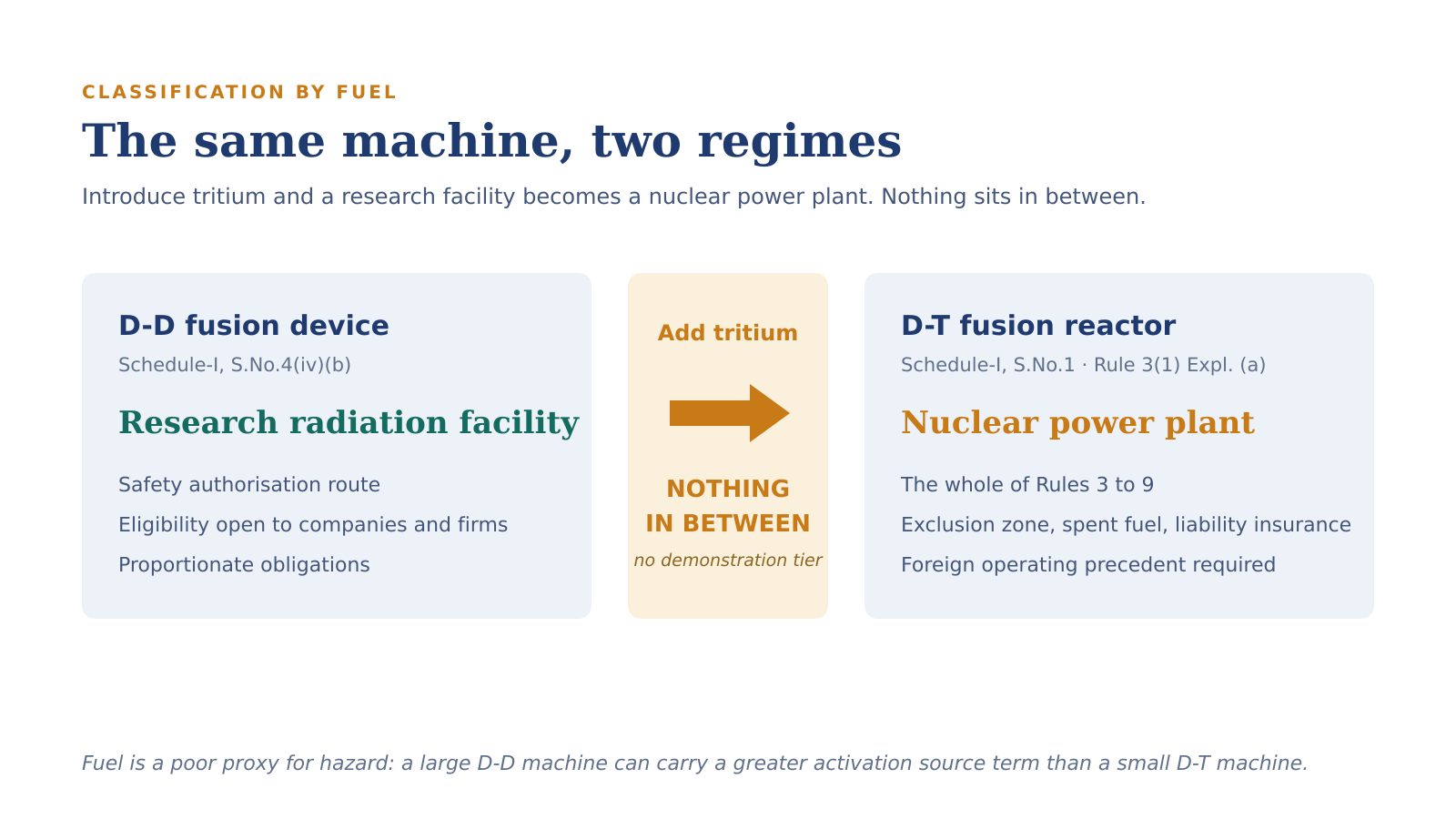
Here is what the drafts do. A device fuelled with deuterium alone is classified in Schedule-I of the Regulations as a radiation facility used in research and education — the lightest category in the entire framework. Introduce tritium, and an Explanation to Rule 3(1) deems the same machine a “reactor”. It is now in the same regulatory box as a nuclear power plant, with everything that follows: a composite licence, an exclusion zone, assured nuclear fuel contracts, spent fuel arrangements, nuclear liability insurance, and a levy to the Spent Fuel Management Fund.
The same machine. The same building. The same people. The regulatory burden differs by orders of magnitude, and there is nothing in between.
I want to be careful about what I am and am not saying. I am not saying tritium is harmless — it is the principal radiological hazard of the fusion fuel cycle, and I will come to how little the drafts actually do about it. I am saying that fuel is a poor proxy for hazard. A large deuterium-only machine can produce more radioactivity in its own structure, through neutron bombardment of the steel around it, than a small tritium machine. Classification should follow the assessed consequence, not the label on the gas bottle.
The fuels that are nowhere at all
There is a sharper version of this problem, and it is the one that persuades me the difficulty is structural rather than a matter of degree.
Deuterium and tritium are not the only fusion fuels. A family of so-called aneutronic reactions produces little or no neutron output at all: deuterium with helium-3, and — the one that most excites people — a proton with boron-11, which yields three helium nuclei and essentially no neutrons. These reactions are very much harder to achieve, requiring temperatures well beyond what a deuterium-tritium plasma needs, and none is close to a power plant. Several serious groups in India and abroad are nonetheless working on them, for an obvious reason: a machine that produces no neutrons activates almost nothing around it, generates no tritium, and leaves behind essentially no radioactive waste.
On any hazard-based view, these are the least hazardous fusion devices imaginable. So where do the drafts put them?
Nowhere. The Explanation to Rule 3(1) extends only to deuterium-tritium. The Schedule-I entry in the Regulations is confined to deuterium-deuterium devices. A proton-boron machine is neither. It has no entry in the schedule, and therefore — by the operation of Regulation 3(1)(b), which grants safety authorisation only to facilities that Schedule-I lists — arguably no route to authorisation at all. The same is true of deuterium-helium-3, though that case is subtler, since deuterium inevitably reacts with itself as a side reaction and produces some neutrons and some tritium along the way.
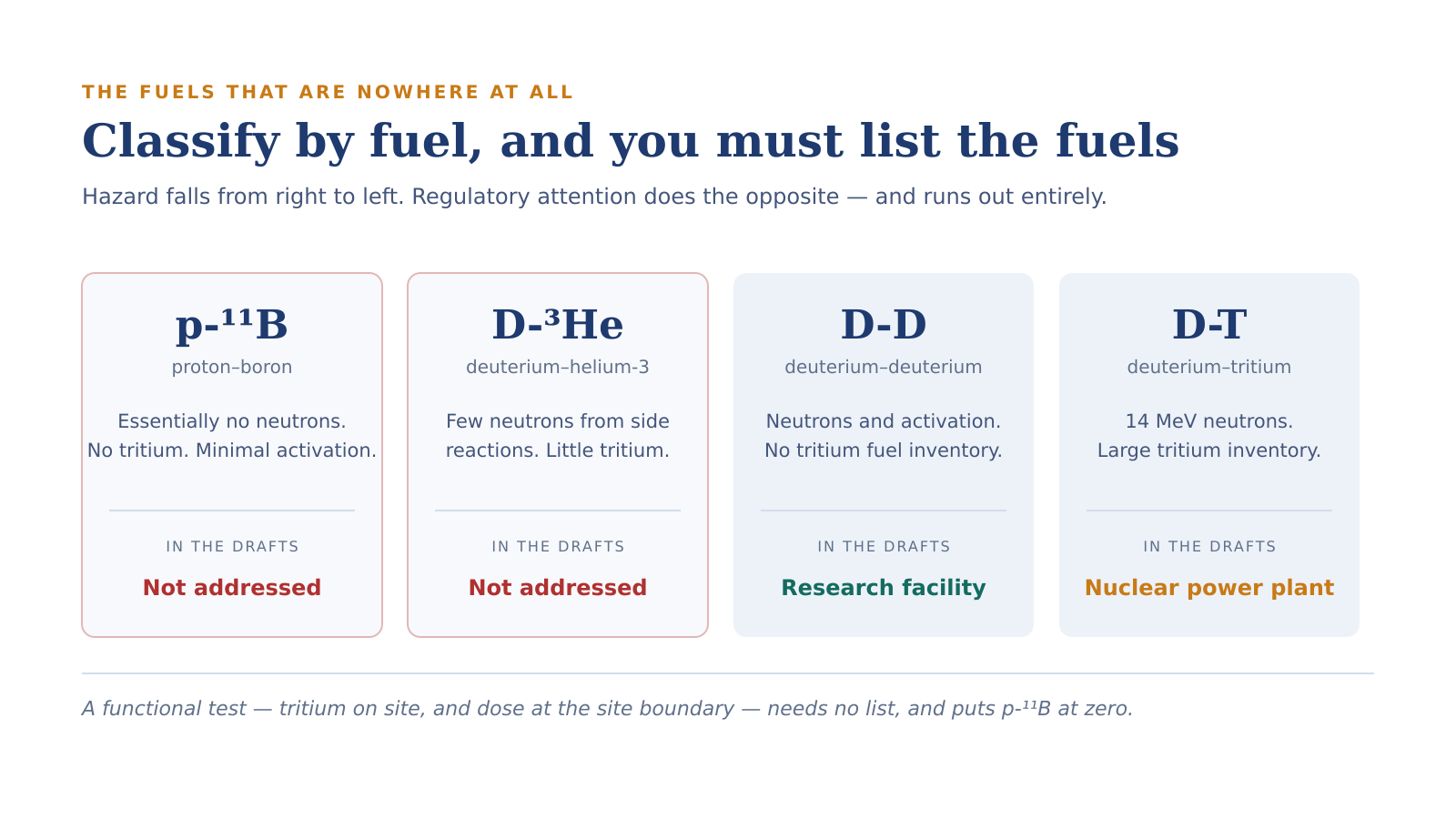
I do not think anyone intended to exclude the cleanest fusion fuels from the framework. It is simply what happens when you classify by fuel: you have to enumerate the fuels, and any list written today will be missing something. A functional test — how much tritium is on site, and what dose could reach the site boundary in the worst credible accident — does not have this problem, because it does not care what is in the gas bottle.
Three provisions that would stop fusion before it starts
Beyond classification, three matters strike me as capable of preventing fusion deployment in India altogether unless they are addressed. None of them, I think, is deliberate. All three are what happens when a framework designed with great care for fission is applied to something that is not fission.
No design can qualify. Rule 3(3)(a) requires that a foreign design be certified in its country of origin and already operational there or somewhere else. Regulation 7 asks for the same evidence again. But no fusion power plant is operational anywhere in the world — that is the entire point of the enterprise. As drafted, these provisions permanently bar the import or acquisition of fusion technology, including from partners with whom India is actively collaborating. The bar is absolute, not discretionary. No amount of safety demonstration can satisfy it.
There is no route for a demonstrator. The Rules provide for bench-scale research at one end and a full reactor licence at the other. Between them sits the machine that actually matters over the next decade: a net-energy demonstrator or pilot plant. It has no licence category. And because Regulation 6 makes safety authorisation available only to someone who already holds a licence, such a facility cannot even reach the Board to be assessed. This is, to my mind, the single most consequential gap in the two drafts.
Tritium is barely regulated at all. It is not mentioned anywhere in the Rules. In the Regulations it appears once, in a table of disposal limits in Schedule-III — but that Schedule is engaged through a proviso confined to isotopes of “very short effective half-life”, and tritium’s half-life is 12.3 years. There is no airborne discharge limit for tritium in either instrument, though that is the dominant routine release pathway of a tritium plant. There is no clear basis for approving a tritium transport package. There is no provision for the urine bioassay by which tritium dose is actually measured.
So we have a framework in which the presence of tritium determines everything about how a facility is regulated, and which does not substantively regulate tritium.
The thorium question
There is a fourth matter that deserves more attention than it will get, because it is specific to India.
A fusion-fission hybrid uses a fusion machine as a neutron source to drive a sub-critical assembly — one that cannot sustain a chain reaction on its own. Feed that assembly thorium, and you have a route to using the resource India has in abundance. Whether hybrids are the right answer is a genuine technical question on which reasonable people differ. My concern is that the drafts do not pose the question at all. A hybrid simply defaults into the full fission regime, with no graded treatment by how sub-critical the assembly actually is. The pathway closes by silence rather than by decision.
Related, and equally consequential: an Explanation to Rule 17 reserves the isotopic separation of prescribed substances to the Central Government. If lithium falls within that, then no one else may enrich lithium-6 — which is what a tritium breeding blanket requires. Without a breeding blanket, no deuterium-tritium plant can sustain its own fuel supply. That is the largest single technical dependency in the whole programme, and its regulatory status is presently unresolved. Either answer would be workable. The silence is not.
What the drafts get right
It would be a poor submission that was uniformly critical, and mine is not. The drafts contain several mechanisms that are precisely what a novel technology needs, and most of what I have proposed works by extending them rather than by inventing anything.
The single composite licence under the proviso to Rule 3(1) is a genuinely good piece of design — one licence to build, own, operate and decommission, rather than a sequence of separate approvals. The Board’s power under Regulation 5 to clear material from regulatory control is exactly the mechanism fusion decommissioning needs, because activated steel decays to harmless levels within decades if you simply wait. The self-authorisation route in Regulation 62(3) is well judged for a field where no certification scheme yet exists. And Regulation 27(1) opens eligibility to any Indian citizen, company, firm or trust — which is more open than the corresponding position under the Rules, and welcome.
The machinery is largely there. What is missing is the express provision that puts fusion inside it.
What I have proposed
In outline: a dedicated Part in the Rules for fusion energy facilities, with three graded tiers, applying to any fusion device irrespective of the fuel employed or the confinement scheme adopted. The quantity of tritium held on site determines who must produce a safety assessment. The dose that assessment predicts at the site boundary, under bounding accident conditions, determines which tier the facility falls into. Research devices below a notified threshold need no licence. Demonstrators register and obtain safety authorisation from the Board. Full power plants take the composite licence. Schedule-I of the Regulations is amended to the same tiers in the same cycle, so that the two instruments say the same thing.
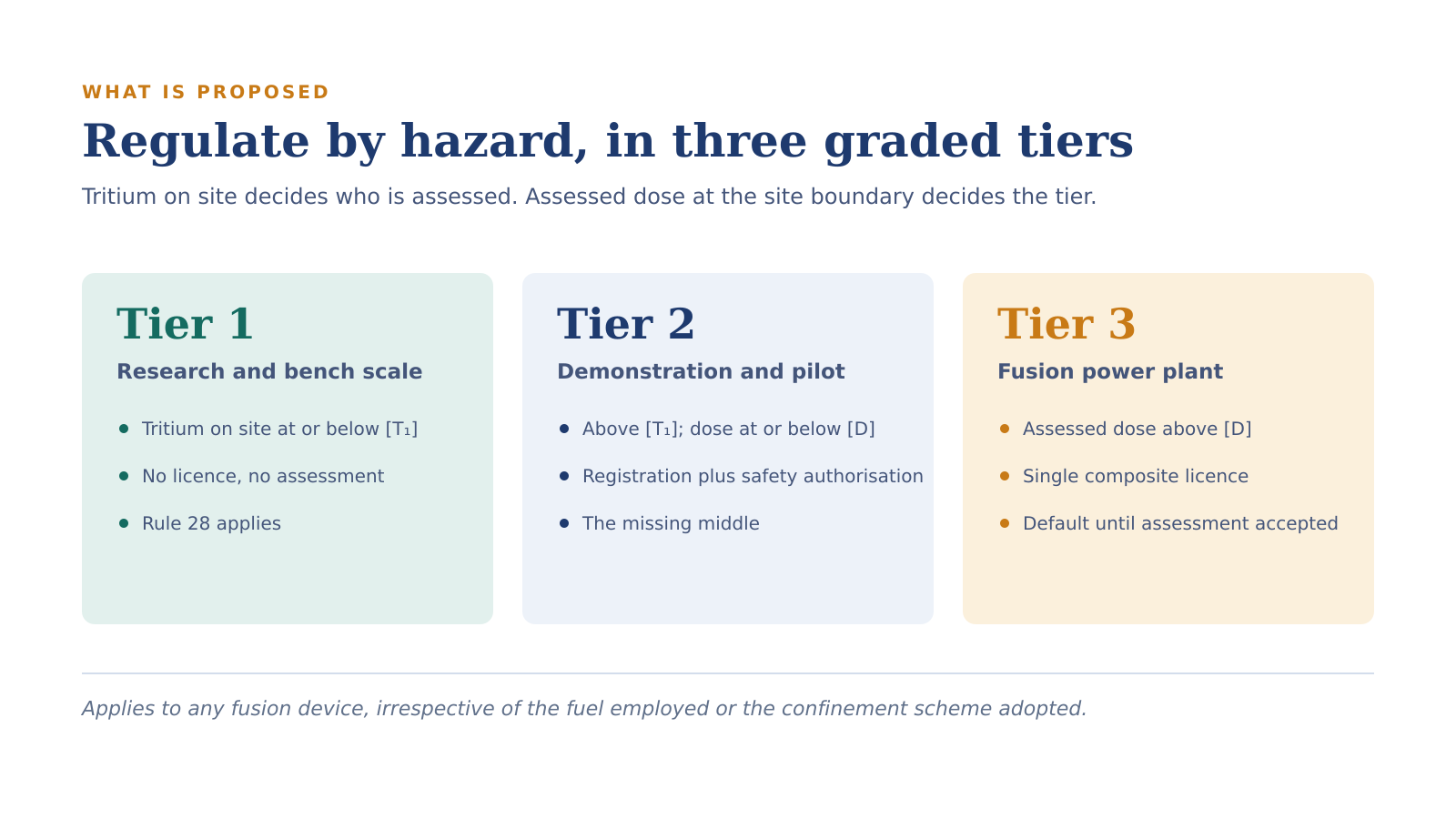
Note what this does for the aneutronic case. A proton-boron device holds no tritium, so it falls below the screening threshold and needs no licence — not because a rule names it, but because the test asks the right question and the answer comes out at zero.
I should be straightforward about how this compares internationally, because it is tempting to overstate it. The United Kingdom has by statute removed fusion from nuclear site licensing. The United States regulates fusion as byproduct material rather than as a reactor. Japan treats fusion devices under its radioisotope legislation. All three took fusion out of the reactor regime and calibrate the burden by assessed dose. But none of them operates a categorical schedule of the kind these instruments use, so none has needed intermediate categories. The tiers I have proposed are India’s own. I offer them as an improvement on the comparators, not as conformity with them, and they should be judged on that basis.
Why you should care, and what you can do
Consultations on subordinate legislation attract almost no attention. That is a mistake. The Act sets the direction; the rules decide what is actually possible. And the officials drafting these instruments have done a substantial and careful job on a very large body of law in a short time. Where I think they have gone wrong, it is not through carelessness — it is because fusion is genuinely unlike the technology the framework was built for, and nobody told them where the joints would fail.
That is what a consultation is for. If you work in plasma physics, materials, cryogenics, tritium handling, radiological protection, or nuclear law — or if you simply have a view about how India should regulate a technology that does not yet exist commercially anywhere — the window is open until 4 September 2026. Comments go to the Department of Atomic Energy for the Rules and to the Atomic Energy Regulatory Board for the Regulations.
My own submission runs to some eighty entries across the two instruments, together with suggested draft text, because I think it is easier to say yes to a specific form of words than to a complaint. I would rather be argued out of any of it than have it go unexamined.
Fusion in India will be decided by a great many things — physics, money, magnets, patience. But it will also be decided by whether a document published on a government website in August 2026 says the word “reactor” in a place where it should not.