

I spent two days at the India Nuclear Energy Forum at IIT Bombay this May, and I came away with one impression more strongly than any other. The people who build and run our fission plants — some of the most capable nuclear engineers anywhere — have, for entirely understandable reasons, not been watching what has happened in fusion over the last five or six years. And the fusion community, equally guilty, has rarely bothered to explain itself in terms a reactor physicist would find useful.
That is a shame, because the two fields are closer to needing each other than either side seems to realise. I want to use this note to close a little of that gap, written deliberately for colleagues who think in cross-sections and neutron budgets rather than press releases.
What changed in fusion while you were busy keeping the grid running
For most of our careers, “fusion” meant one thing: a very large tokamak, decades away, funded by governments. ITER is real and important, but it shaped a perception that fusion is monolithic and remote. That perception is now out of date in two specific ways.
First, the magnet problem has largely been solved by materials, not by scale. High-temperature superconductors — REBCO tapes in particular — let us reach the field strengths that used to require enormous low-temperature magnets, in machines a fraction of the size. A high field at a small radius changes the entire economic argument, because confinement and reaction rate scale steeply with field. This is why the credible new private programmes are an order of magnitude smaller than ITER and still expect meaningful performance.
Second, and more relevant to this audience, the field has rediscovered configurations the fission community would find refreshingly simple. I work on the axisymmetric magnetic mirror — the Gas Dynamic Trap lineage from Budker Institute in Novosibirsk, recently validated by the WHAM experiment at Wisconsin and its commercial successor. A linear mirror is not a closed toroidal device. It is, conceptually, a long straight magnetic bottle. It is easier to build, easier to maintain, and — crucially — it is an excellent neutron source even when its energy gain is modest. Hold that last point; it is the whole argument.
The deeper shift is one of intent. A generation of fusion programmes asked only one question: when do we put electricity on the grid? The newer programmes ask a different one first: what is fusion good for before it is a power plant? And the honest answer is that a fusion device is, first and foremost, a controllable, intense source of fast neutrons. That reframing is what should interest you.
Why a fusion neutron is different
A deuterium–tritium reaction releases 17.6 MeV, of which 14.1 MeV leaves as a neutron. Compare that with the roughly 2 MeV average of a fission neutron. The factor of seven in energy is not a curiosity — it opens reaction channels that are simply closed to a thermal or even a fast fission spectrum.

At 14 MeV you get neutron multiplication almost for free. Inelastic and (n,2n) channels in beryllium and lead mean a blanket can return more neutrons than it receives. That surplus is the resource. In a critical reactor every neutron is spoken for — you live or die by the six-factor formula and you have almost no margin to spend neutrons on anything that does not sustain the chain. A fusion source hands you a neutron budget you do not have to balance against criticality.
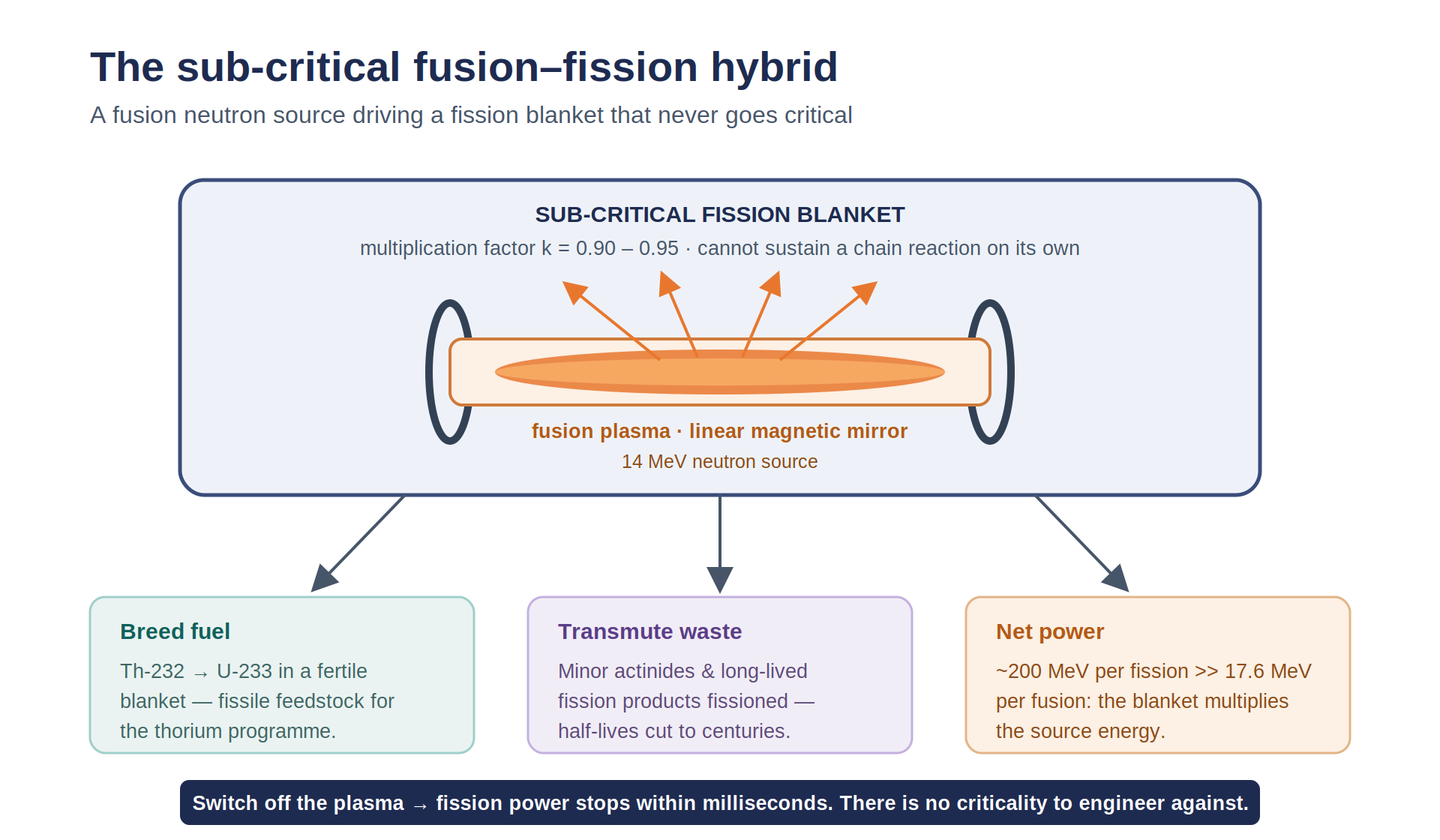
What you choose to do with that surplus — breed fuel that has eluded our thorium programme for decades, burn the waste that fills our repositories, and generate power without the assembly ever going critical — is exactly where our two fields meet.
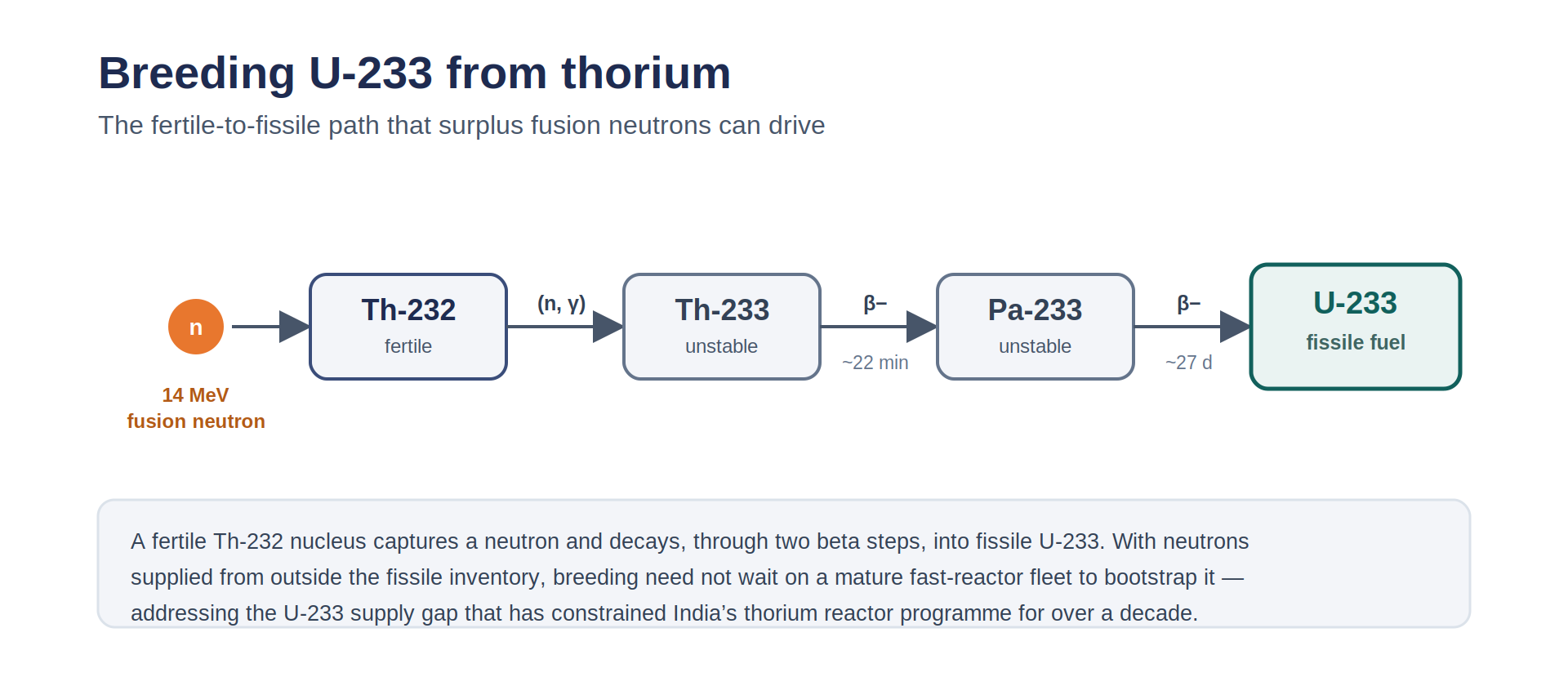
You can breed fuel with it. Surround the source with a fertile blanket and the surplus neutrons do exactly what Bhabha’s three-stage vision always needed them to do. Th-232 captures a neutron, decays through Pa-233, and becomes U-233. The arithmetic that has frustrated the thorium programme for decades — that you need fissile material to make fissile material, and the doubling times of fast breeders are long — looks different when the neutrons come from outside the fissile inventory. A fusion-driven blanket is, in principle, a U-233 factory that does not have to wait for a mature fast-reactor fleet to bootstrap it. For a country holding one of the world’s largest thorium endowments — conservatively on the order of an eighth of global reserves on IAEA and USGS estimates, against barely one to two per cent of global uranium — that is not a marginal point.
You can burn your waste with it. The minor actinides — neptunium, americium, curium — and the long-lived fission products that dominate our repository headaches are difficult to destroy in a thermal spectrum and awkward to make critical on their own. A hard, intense neutron field fissions them efficiently. Drive a sub-critical assembly loaded with separated minor actinides using a fusion source, and you transmute the most troublesome part of the back end of the fuel cycle into shorter-lived or fission-product material. The half-life arithmetic of geological disposal changes from hundreds of thousands of years to a few hundred.
And you can do both sub-critically, which is the safety argument. This is the part I most want fission colleagues to sit with. Because the neutron source is external, the fission blanket need never be critical. Run it at a multiplication factor between 0.90 and 0.95 and the assembly cannot sustain a chain reaction by itself. Switch off the source — the plasma, in our case — and fission power follows within milliseconds. There is no criticality excursion to engineer against because there is no criticality to begin with. The accelerator-driven systems community has made this case for years; MYRRHA at SCK CEN is the benchmark. A fusion neutron source is simply another, arguably better, way to drive the same sub-critical physics, with the bonus of breeding tritium in the same blanket.
The point you will object to, answered
The reactor physicist’s immediate objection is the right one: fusion does not yet reach engineering break-even, so how can it drive anything?
The answer is energy multiplication, and it is the reason the hybrid is a near-term idea rather than a distant one. A sub-critical blanket multiplies each source neutron’s worth many times over, because each fission delivers about 200 MeV against the 14 MeV that triggered the cascade. A fusion core that would be a commercial failure as a standalone power plant — modest gain, modest neutron output — can still anchor a hybrid that produces useful fissile material, burns actinides, and puts net power on the grid. The hybrid forgives the fusion core almost everything we have spent fifty years struggling to achieve. That is precisely why a linear mirror, never the front-runner for pure fusion power, becomes a serious commercial neutron source in this role.
So the sequence is not “fusion power, then everything else.” It is the reverse. Neutron sources for medical isotopes and non-destructive evaluation first, because those markets pay today. Then a fusion–fission hybrid that breeds, transmutes, and generates — the application where fusion’s weaknesses stop mattering. Pure fusion power last, funded by the rest. At ASPL we call this the staircase; you may call it sensible neutron economics.
Why this is an Indian conversation, not an imported one
None of the above requires us to import a solution. The HTS conductor work is happening at BARC and IIT Madras. The plasma physics heritage sits at the Institute for Plasma Research, in ADITYA and SST-1 and now defunct SINP Tokamak. The sub-critical and ADS expertise lives within the DAE establishment already. The thorium cycle is our national programme, not anyone else’s. What was missing was a legal pathway for private capital and private speed to join the public capability — and the SHANTI Act, in force since December, has now provided it.
The U-233 supply gap that has held back AHWR and the molten-salt thorium designs for over a decade is, at root, a neutron-source problem. India has the downstream reactor designs. A fusion-driven breeding node is one credible way to feed them, and it is a role the private sector can take on as upstream supplier while DAE, BARC and NPCIL do what only they can do downstream.
An invitation
I am not asking the fission community to believe that fusion power is around the corner; I have spent my career being sceptical of that claim and I remain so. I am asking something narrower and, I think, harder to dismiss: that a fast-neutron source with a surplus neutron budget is a tool your field has wanted for a long time, and that such sources are now being built — some of them in India.
The breeding, the transmutation, the sub-critical safety case — these are fission problems with a fusion answer, and they do not depend on fusion ever lighting a single bulb. If even a few of the people I met at IIT Bombay leave thinking of fusion as a neutron source rather than a distant power plant, the conversation we should have started years ago will finally be underway.
I would welcome it. My colleagues and I are easy to find.